




Custom Wooden Crafts Wholesale: How to Reduce Sourcing Costs Without Loss of Quality (2026)
For wholesale buyers and retailers, sourcing custom wooden crafts presents a persistent challenge: reducing procurement costs while maintaining craftsmanship quality. The answer lies not in cutting corners, but in strategic sourcing decisions that eliminate waste and inefficiency—potentially reducing costs by 20-35% without sacrificing quality.
Introduction
The global wooden crafts market continues to grow, with buyers seeking everything from handcrafted animal carvings to custom desktop decorations. However, many businesses overpay due to inefficient sourcing—working with middlemen, ordering incorrect quantities, or failing to specify requirements clearly. This guide provides practical strategies to reduce your sourcing costs without sacrificing the quality that defines your brand.
Understanding Your True Sourcing Costs
Your true sourcing cost includes far more than the quoted price per piece. Production costs typically represent only 40-50% of total landed costs. Additional expenses include sampling fees ($50-200 per design), shipping (15-25% air freight, 8-12% sea freight), customs duties and taxes, payment processing fees (2-4%), quality inspection costs ($200-500 per batch), and storage/handling fees.
Hidden costs from poor planning: Rush orders add 30-50% to production costs; unclear specifications lead to revision rounds adding 2-3 weeks and 15-20% extra costs; low-volume orders result in 40-60% higher per-unit pricing; design changes mid-production cause delays and $100-300 in additional tooling fees.
Calculate true cost per unit: Total Cost = (Unit Price × Quantity) + Sampling + Tooling + Shipping + Duties + Inspection + Payment Fees + (Defect Rate % × Unit Price × Quantity).
For example, ordering 500 wooden figurines at $8 each: base $4,000 + sampling $150 + shipping (20%) $800 + duties (6%) $240 + inspection $300 + payment fees (3%) $120 + defects (2%) $80 = $5,690, or $11.38 per unit—42% higher than quoted price.
Strategic Supplier Selection
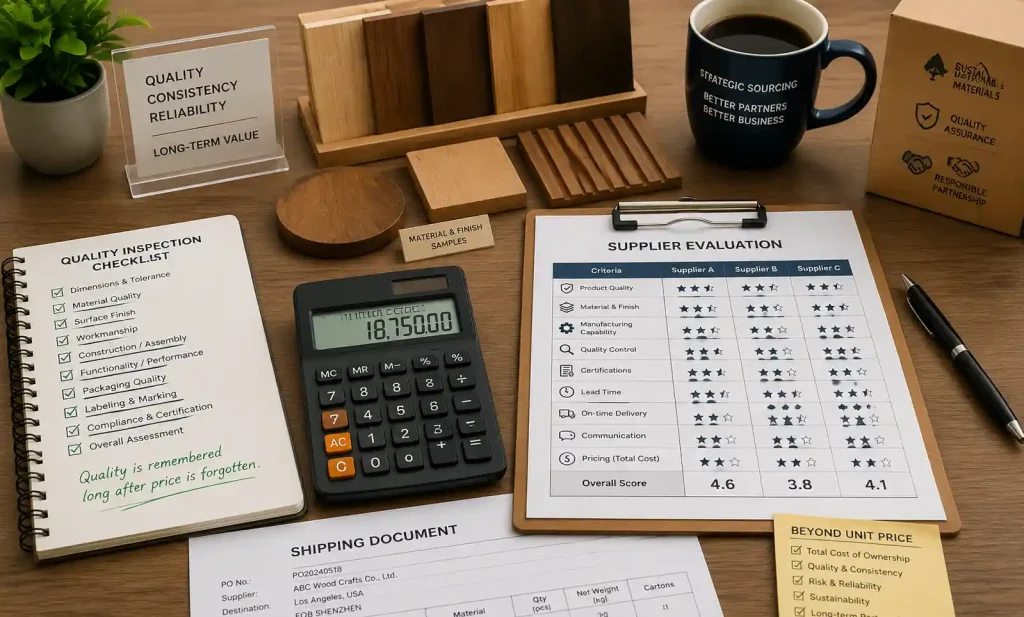
Direct Manufacturer vs. Trading Company: Direct manufacturers eliminate 15-30% middleman markups, offer better customization flexibility, and provide direct quality oversight—but may require higher MOQs (300-500 vs 100-200). Trading companies offer broader product portfolios, lower initial MOQs, and English-speaking account management—but add 15-30% markup.
Cost-saving decision: For recurring orders over 500 units, direct manufacturers typically save 20-25% long-term. For diverse smaller orders, trading companies may prove more efficient.
| Evaluation Factor | What to Check | Cost Impact |
|---|---|---|
| Production capacity | Daily output, number of artisans | Affects lead time and rush fees |
| Wood sourcing | Direct timber contracts vs. spot buying | 10-15% material cost difference |
| Equipment quality | Modern vs. outdated carving tools | Impacts defect rates (2-8%) |
| Quality system | ISO certification, inspection process | Reduces rejection costs |
| Export experience | Years in business, client portfolio | Fewer shipping and customs issues |
| Payment terms | Deposit requirements, balance timing | Affects cash flow and financing costs |
Request references from buyers in your market segment. Suppliers experienced in wholesale decorative carvings for your target market understand packaging requirements, wood treatment regulations, and cultural design preferences—reducing costly mistakes.
Material Optimization Without Quality Compromise
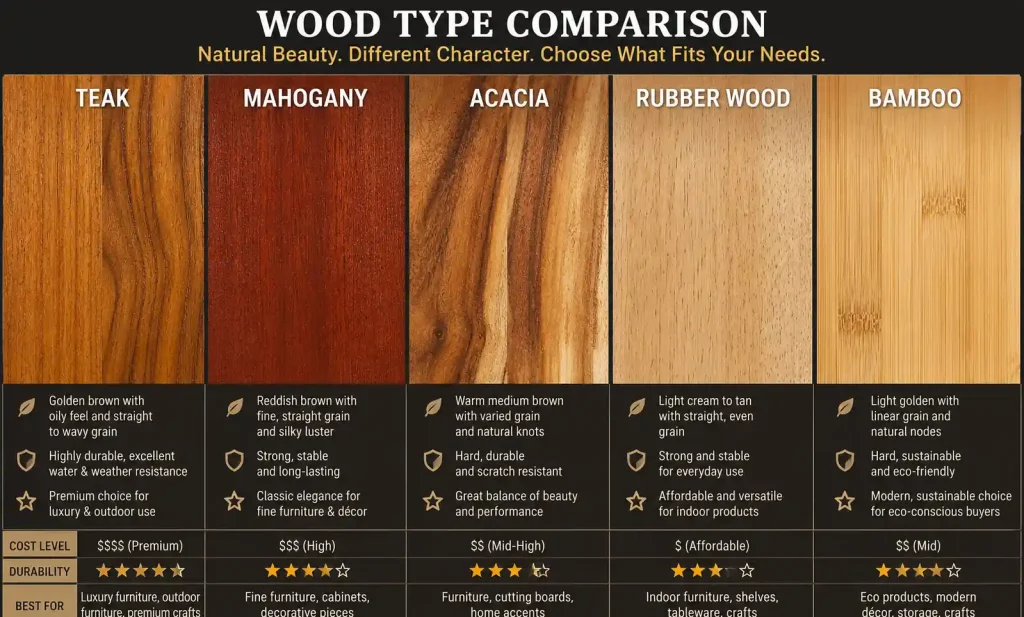
Strategic wood selection can reduce costs by 25-40% while maintaining aesthetic appeal.
| Wood Type | Cost Level | Characteristics | Best Applications |
|---|---|---|---|
| Teak | $$$ | Golden-brown, moisture-resistant | High-end decor, outdoor |
| Mahogany | $$$$ | Rich red-brown, fine grain | Statement pieces, traditional |
| Acacia | $$ | Varied grain, sustainable | Mid-range decorative items |
| Rubber wood | $ | Light color, sustainable | Budget pieces, painted items |
| Bamboo | $ | Eco-appeal, modern aesthetic | Contemporary, eco-conscious |
Key insight: For painted/stained pieces, rubber wood provides identical appearance to teak at 60-70% lower cost. For decorative items with protective coatings, acacia delivers teak-like aesthetics at nearly half the cost. For eco-conscious retailers, bamboo products command premium pricing despite lower material costs.
Reduce material waste: Skilled workshops achieve 75-85% material efficiency vs 60-70% for less experienced operations—a 15-20% direct cost impact. Specify dimensional flexibility (±5-10mm on non-critical dimensions) lets manufacturers cut more pieces per board. Design around standard timber sizes (25mm, 50mm, 75mm thicknesses) improves yield by 10-15%.
Smart Order Strategies for Better Pricing
Find your optimal order quantity: MOQ is the manufacturer’s minimum, not your optimum. The sweet spot typically falls at 3-5 times MOQ.
Example pricing for wooden figurines: 100 units ($12.00/unit) → 300 units ($9.50, 21% saving) → 500 units ($8.00, 33% saving) → 1,000 units ($7.50, 38% saving) → 2,000 units ($7.20, 40% saving). The steepest decline occurs between MOQ and 500 units. Beyond 1,000 units, savings flatten to 1-2% increments.
For multiple designs, consolidate into single purchase orders. Ordering three designs at 400 units each (1,200 total) often qualifies for bulk-tier pricing individual orders wouldn’t receive.
Leverage production timing: Low-season ordering (January-March for wooden crafts) brings 10-15% discounts to fill capacity gaps. Production lead times expand 30-40 days, reducing rush pressure. For peak-season delivery (September-November), order 4-5 months early during shoulder season to save 15-20%.
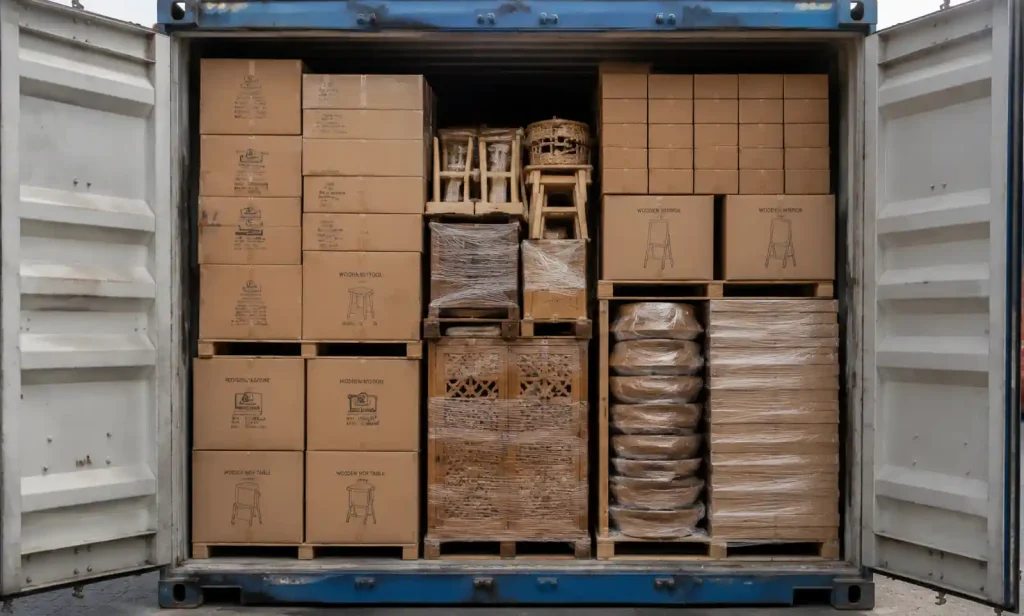
Consolidate shipments: Shipping represents 15-25% of landed costs. Combine multiple product categories in one container. Partner with other non-competing importers to share container space. Use warehouse consolidation services in manufacturing regions. A 20-foot container ($2,500-4,000 sea freight) at 90% capacity vs 60% reduces per-unit shipping costs by 33%.
Quality Control Systems That Save Money
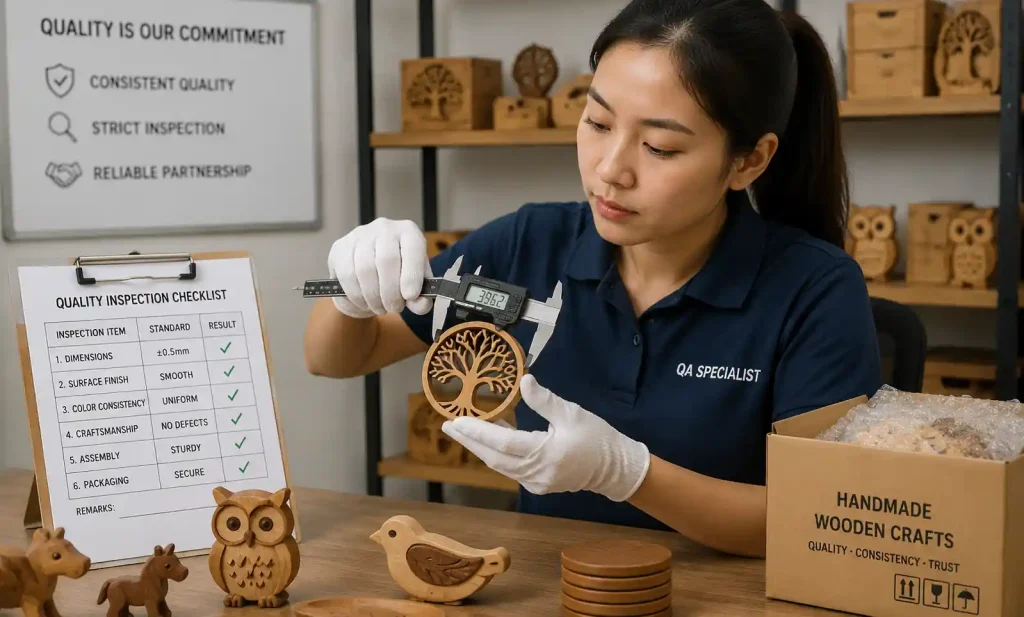
Quality problems cost far more than quality prevention. Defect rates range from 2% (excellent) to 12% (problematic). For 1,000 units at $8 each, reducing defects from 8% to 3% saves $400 in direct costs, plus reshipping ($300-600), customer dissatisfaction, and delayed market entry.
Prevent defects through clear specifications: Provide exact dimensions with tolerances, acceptable wood species/grades, finish requirements, carving detail expectations with reference photos, and packaging specifications. A $50 reference sample prevents thousands in misproduction.
Implement staged inspections:
- Pre-production approval: Review materials, dimensions, first completed sample before mass production ($50-100 sample revision vs $2,000-5,000 rejection)
- In-process inspection: Check 20-30% through production—correction costs 70-80% less
- Final inspection: Random samples (10-15%) per AQL standards ($250-400 vs $3,000-8,000 return shipping/reproduction)
Build long-term supplier relationships: After 3-4 orders, expect 5-10% lower pricing as setup costs amortize, priority scheduling, flexible payment terms, and first access to new designs. Maintain 2-3 core suppliers—single-sourcing creates dependency; over-diversification prevents relationship depth.
FAQ
What is a reasonable MOQ for custom wooden crafts?
Simple items (beads, pendants): 500-1,000 pieces. Medium complexity (animal figurines): 300-500 pieces. Complex carved pieces: 100-300 pieces. Optimal pricing comes at 3-5 times MOQ.
How much should I budget for sampling and tooling?
$50-150 per design for simple modifications; $150-300 for completely new designs; $100-500 for specialized carving patterns. Most manufacturers credit sampling fees against production orders exceeding 500 units. Budget 2-3% of first order value.
Should I use air or sea freight?
Sea freight costs 60-75% less but takes 25-35 days vs 5-7 days air. For orders over 100kg, sea freight is more economical unless urgent. For regular reorders, plan 60-90 days ahead and use sea freight to reduce shipping costs by 15-20% of landed cost.
How can I verify manufacturer quality before large orders?
Request samples of existing products. Visit the facility if possible, or hire local inspection ($300-500). Check references. Start with a trial order at 1.5-2× MOQ. For orders over $10,000, use third-party pre-shipment inspection ($250-400).
What payment terms are standard?
New relationships: 30-50% deposit, 50-70% balance before shipment. After 2-3 successful orders: negotiate 30% deposit, 70% balance with 7-15 day terms. Letters of credit add $200-500 in fees but provide security for first-time large orders.
Can I reduce costs by handling finishing/assembly in my market?
Yes, by 15-25% for items requiring market-specific staining, local assembly, or final quality control. Factor in your labor costs, workspace needs, and time—works best for retailers with existing workshop capabilities.
How do I handle quality issues after receiving goods?
Document defects immediately with photos. Contact suppliers within 48 hours. Remedies include credit toward next order (3-5% defect rates), partial refund (5-10% defects), or reproduction/reshipping (>10% defects). Prevention through clear specs and pre-shipment inspection costs far less.

Conclusion
Reducing sourcing costs without quality loss requires strategic thinking across supplier selection, material optimization, order structuring, and quality management. The approaches outlined here can reduce procurement costs by 20-35% while maintaining product quality.
Immediate actions:
- Audit your true cost per unit including all hidden expenses
- Request quotes from 3-4 direct manufacturers
- Identify opportunities to consolidate orders or adjust timing
- Implement three-stage quality inspection for your next order
Focus on total value rather than lowest price, invest in clear specifications, and build relationships with manufacturers who understand your market requirements.