



دليل المصنعين لتوريد المنحوتات الخشبية المخصصة من الصين: خدمات التصنيع حسب الطلب (OEM) وتصميم المنتجات حسب الطلب (ODM) من المخطط الأولي إلى الإنتاج (2026)
Key Takeaways (Quick Summary)
- OEM vs ODM: OEM = your design, your exclusivity, longer timeline (8–14 weeks). ODM = factory design, faster (6–10 weeks), lower minimums, but designs may not be exclusive.
- Material selection drives cost: Basswood ($) for intricate carving, Teak ($$$) for outdoor durability, Walnut ($$$$) for luxury appeal. FSC certification matters for European and North American markets.
- MOQ typically ranges 100–1,000 pieces — complex OEM designs require higher minimums to amortize tooling costs ($200–$1,500).
- Plan 6–14 weeks total from design to delivery. Add 2–4 weeks buffer for Chinese New Year (late Jan–Feb) and peak export seasons (Sep–Nov).
- Payment terms: 30–40% deposit upfront, balance before shipment. Net-30/60 available for established relationships.
- Import duties: 0–6% for wooden decorative articles into the US; VAT 15–25% in EU markets. Factor these into your landed cost.
Understanding OEM vs ODM in Wood Carving
The distinction between OEM and ODM manufacturing models fundamentally shapes your sourcing strategy, timeline, cost, and intellectual property protection.
OEM (Original Equipment Manufacturer) — You provide complete design specifications, technical drawings, and dimensional requirements. The factory executes your vision precisely. This model suits businesses with established designs, proprietary product lines, or specific brand aesthetics. Key advantage: Your design remains exclusive to your brand. Trade-off: Longer development cycles (custom tooling, carving templates, production procedures) and typically higher MOQs.
ODM (Original Design Manufacturer) — The manufacturer offers pre-existing designs from their catalog or creates new designs based on your conceptual direction rather than detailed technical drawings. You describe the style, size range, and intended application; the manufacturer’s design team develops the product. Many ODM partners maintain extensive design libraries spanning animal carvings, decorative sculptures, functional items, and cultural motifs. Key advantage: Faster time-to-market, lower MOQs, no tooling fees. Trade-off: Designs may be available to other buyers unless you negotiate exclusivity.
Hybrid Model — Increasingly popular: select a base design from the manufacturer’s ODM catalog, then request modifications to dimensions, wood species, finish treatments, or decorative details. This balances design efficiency with customization, reducing development time while maintaining product differentiation. China remains the world’s dominant force in wood carving manufacturing, with specialized clusters in Shandong (hand-carved crafts, religious figurines, holiday décor), Zhejiang (CNC precision work), and Guangdong (automated finishing lines).
Decision Framework:
| Factor | Choose OEM | Choose ODM |
|---|---|---|
| Design ownership | You own it exclusively | Factory owns it (unless negotiated) |
| Timeline | 8–14 weeks | 6–10 weeks |
| MOQ | Typically 500–1,000+ pieces | 100–500 pieces |
| Tooling/setup fees | $200–$1,500 | None or minimal |
| Best for | Branded products, proprietary designs | Testing new markets, faster launch |
From Blueprint to Sample: The Design Phase
The design phase establishes the foundation for successful production. For OEM projects, you’ll submit technical drawings including orthographic views (front, side, top), dimensional specifications with tolerances, wood grain orientation preferences, and surface finish requirements. Professional drawings should note critical dimensions, weight targets, wall thickness for hollow carvings, and any functional requirements such as mounting points or structural load considerations.
Manufacturers review these specifications for feasibility, considering wood behavior, grain direction limitations, carving tool accessibility, and structural integrity. Experienced factories provide design feedback, suggesting modifications that improve manufacturability without compromising aesthetics. A dragon carving with an extended tail might need internal reinforcement; a thin-walled decorative box requires specific wood species with fine, stable grain.
| Design Input Type | OEM Requirements | ODM Requirements | Development Timeline |
|---|---|---|---|
| Technical drawings | Complete CAD files or detailed blueprints | Conceptual sketches or reference images | 7–14 days review |
| Dimensional specs | Precise measurements with tolerances (±0.5mm) | Approximate size range | 3–5 days review |
| Material preferences | Specific wood species and grade | General characteristics (dark/light, grain type) | Immediate if in stock |
| Surface finish | Detailed finishing protocol | Standard finish options | 2–3 days sampling |
| Decorative details | Exact replication requirements | General style direction | 5–10 days prototyping |
Once specifications are approved, the manufacturer creates an initial sample. This prototype undergoes multiple iterations, addressing dimensional accuracy, surface quality, detail sharpness, and overall aesthetic. Expect two to four sample rounds for complex OEM designs. ODM products typically require one to two samples as the base design already exists. Some manufacturers offer free samples for standard ODM designs; OEM prototypes may incur fees of $100–500, typically credited toward production orders.
Digital communication accelerates this phase. High-resolution photographs from multiple angles, detailed measurement annotations, and video walkthroughs help remote approval. However, physical samples remain essential for evaluating wood texture, color accuracy, weight, and tactile quality—aspects that photographs cannot fully convey.
Material Selection and Sourcing
Wood species selection profoundly impacts the final product’s appearance, durability, workability, and cost. China imports most of its hardwood from Brazil, Russia, and Southeast Asia. Manufacturers typically maintain relationships with certified timber suppliers, ensuring legal sourcing and quality consistency.
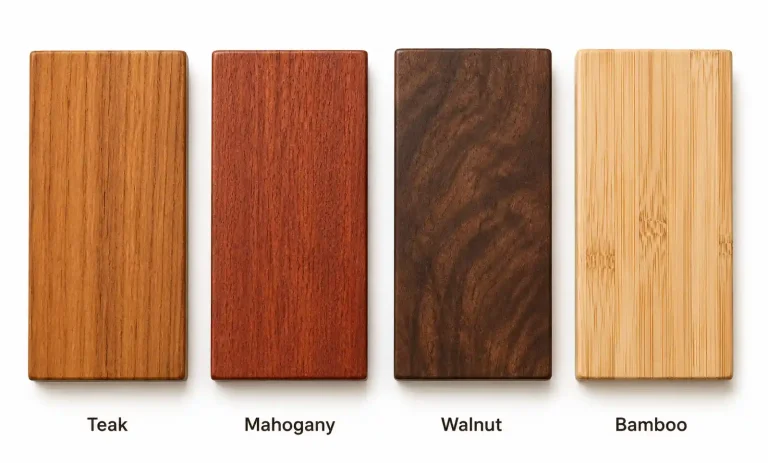
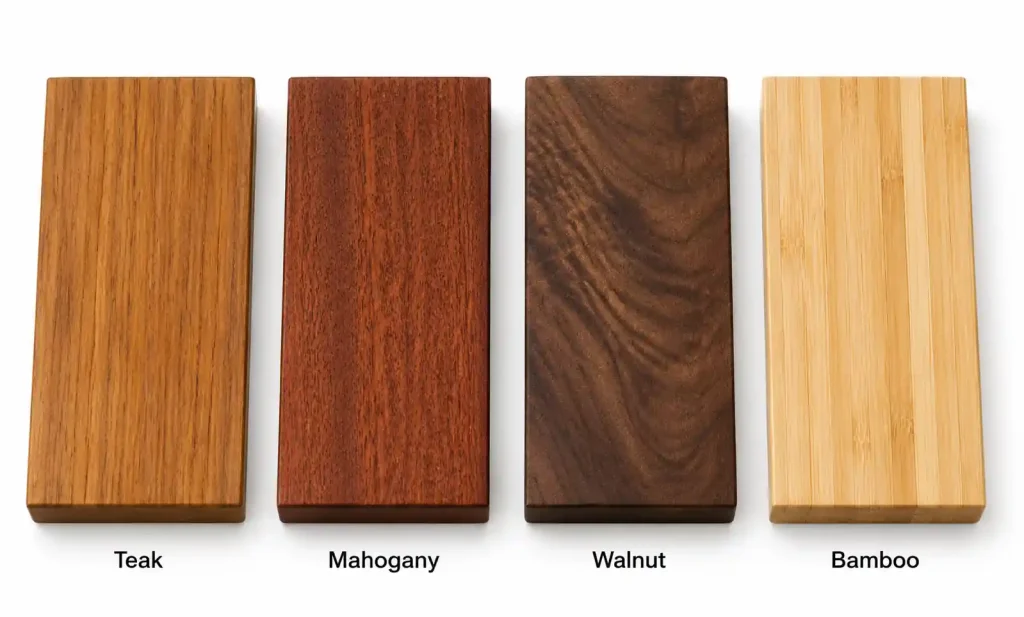
خشب الساج — Prized for its rich golden-brown color and natural oils that resist moisture and insects. Tight, straight grain carves cleanly with fine detail retention. Suits outdoor applications, bathroom accessories, and high-humidity environments. Price: $$$
الماهوجني — Reddish-brown hue with excellent workability and dimensional stability. Medium density accommodates intricate carving while maintaining structural strength. Finishes beautifully, developing a lustrous patina with age. Suits furniture-quality decorative carvings, awards, and corporate gifts. Price: $$$ (CITES regulated)
الجوز — Deep chocolate tones with striking grain patterns. Hardness supports fine detail; density creates satisfying weight in hand-held items. Projects luxury and sophistication—ideal for high-end retail, collector pieces, and executive gifts. Price: $$$$
خشب الورد — Deep red with dark streaks. Extremely hard (Janka 1,780–3,170 lbf). Used for small decorative items and inlay work. Highly regulated under CITES. Price: $$$$$
Bamboo — Sustainable alternative with rapid growth cycles. Unique linear grain and natural segmentation create distinctive aesthetics. Compressed bamboo achieves hardness comparable to traditional hardwoods. Suits eco-conscious brands and products marketed for sustainability. Price: $$
Basswood — Pale cream color with minimal grain. Softest option (Janka 410 lbf). Ideal for intricate carving and painting because it holds fine detail without splitting. Readily available and cost-effective. Price: $
| Wood Species | اللون والملمس | الصلابة (جانكا) | أفضل التطبيقات | Sustainability | النطاق السعري |
|---|---|---|---|---|---|
| خشب الساج | Golden-brown, straight grain | 1,000–1,155 lbf | Outdoor decor, moisture-prone items | Plantation-grown available | $$$ |
| الماهوجني | Reddish-brown, fine grain | 800–900 lbf | Decorative sculptures, awards | CITES regulated | $$$ |
| الجوز | Dark brown, figured grain | 1,010 lbf | Luxury items, collector pieces | Well-managed forests | $$$$ |
| خشب الورد | Deep red with dark streaks | 1,780–3,170 lbf | Small decorative items, inlay | Highly regulated | $$$$$ |
| Bamboo | Light tan, linear pattern | 1,180–1,380 lbf | Eco-friendly products | Highly sustainable | $$ |
| Basswood | Pale cream, minimal grain | 410 lbf | Intricate carving, painting base | Readily available | $ |
Certifications to request: FSC (Forest Stewardship Council) or PEFC (Programme for the Endorsement of Forest Certification) confirm sustainable forestry practices. For certain species, verify CITES compliance ensuring legal harvest and trade.
Manufacturing Process and Quality Control
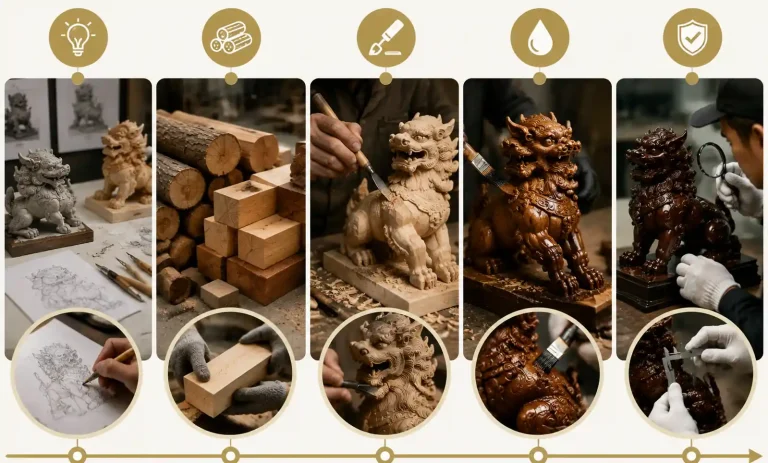
Professional wood carving manufacturing combines traditional handcraft with modern efficiency. The process follows a proven workflow:
Step 1: Material Preparation — Lumber undergoes kiln drying to target moisture content: 8–12% for indoor products, 12–15% for outdoor applications. Proper drying prevents warping, cracking, and dimensional changes after production. This is critical—wood that hasn’t been properly dried will move after manufacturing, causing customer returns.
Step 2: Rough Cutting — Basic forms are shaped using band saws or CNC routers for dimensional accuracy. CNC technology excels at producing multiple identical pieces with consistent dimensions, essential for OEM orders requiring uniformity across large quantities. Some manufacturers achieve tolerances within ±0.1mm using precision CNC equipment. The machine establishes primary contours, leaving material for hand-carving details.
Step 3: Hand Carving — Skilled artisans execute detailed carving work. Different techniques suit different design elements: relief carving for dimensional decoration on flat surfaces, round carving for fully three-dimensional sculptures, and chip carving for geometric patterns. Master carvers work from reference samples, maintaining consistency across production runs while allowing subtle variations that characterize authentic handwork.
Step 4: Surface Finishing — Raw carved wood becomes polished product through progressive sanding (typically 100 to 400 grit), achieving smooth surfaces without obscuring wood grain or softening carved details. Some manufacturers employ rotating brushes to burnish surfaces, creating lustrous finishes without chemical treatments.
Step 5: Finish Application — Protects wood and enhances appearance. Options include natural oil finishes (penetrate wood fibers while maintaining natural texture), lacquer (glossy protective coating), and wax finishes (traditional matte aesthetics). Choose based on intended use: food-safe finishes for kitchen items, UV-resistant treatments for outdoor applications, durable lacquers for frequently handled objects.
Quality Control Checkpoints:
- Initial material inspection — Confirms wood grade and moisture content
- Mid-production checks — Verify dimensional accuracy and detail quality
- Final inspection — Examines finish uniformity, structural integrity, and packaging protection
Reputable manufacturers document quality procedures and maintain inspection records. Request information about their quality management systems, inspector qualifications, and defect rates for similar products. Factories serving export markets typically implement robust quality protocols understanding that returns and replacements across international borders prove costly.
Production Timeline and Capacity Planning
Realistic timeline expectations prevent frustration and ensure successful launches. The complete OEM/ODM journey from initial contact to delivered goods typically spans six to fourteen weeks, varying with project complexity, material availability, order quantity, and season.
Design and Sampling Phase: Initial design review and feasibility assessment take one to two weeks for OEM projects with complete specifications, potentially longer if drawings require clarification or modification. ODM projects with catalog selection move faster, often finalizing within days. Sample production and approval cycles add two to four weeks, including production time, shipping, feedback, and iteration.
Production Phase: Once samples receive approval, production begins:
| كمية الطلب | Simple Design Timeline | Complex Design Timeline | Artisan Hours per Piece |
|---|---|---|---|
| 100–500 pieces | 2–3 weeks | 3–5 weeks | 0.5–1 hour |
| 500–1,000 pieces | 3–4 weeks | 4–6 weeks | 1–2 hours |
| 1,000–2,000 pieces | 4–6 weeks | 6–8 weeks | 2–4 hours |
| 2,000–5,000 pieces | 6–8 weeks | 8–12 weeks | 4–6 hours |
| 5,000+ pieces | 8–10 weeks | 12–16 weeks | Varies |
Shipping Phase: Sea freight from Chinese ports to North America or Europe takes 3–6 weeks. Air freight accelerates to 5–10 days but costs significantly more.
Seasonal Considerations:
- Chinese New Year (late January through February): Factories close for one to three weeks; material suppliers operate minimally. Plan orders to avoid this window or confirm capacity early.
- Peak export seasons (September through November for holiday inventory): Increased demand competes for production capacity.
Buffer Time: A project with an eight-week quoted timeline should begin at least ten weeks before your deadline, accommodating potential sampling revisions, material delays, or quality issues requiring partial reproduction.
Pricing Structure and MOQ Considerations
Understanding wood carving pricing helps set realistic budgets and negotiate effectively. Pricing comprises several components:
| Pricing Component | Cost Impact | Negotiation Leverage | Volume Sensitivity |
|---|---|---|---|
| Material (standard species) | 15–25% of unit cost | Limited, market-driven | Lower per unit at high volume |
| Material (exotic hardwoods) | 30–45% of unit cost | Minimal, specialty item | Some savings at high volume |
| Carving labor | 40–60% of unit cost | Moderate with long-term commitment | Efficiency gains at scale |
| Tooling/setup (OEM) | $200–$1,500 flat fee | Negotiable with volume commitment | Amortized across quantity |
| Finishing | 8–12% of unit cost | محدود | Some efficiency at scale |
| Packaging | 5–10% of unit cost | Moderate flexibility | Better rates at high volume |
| Quality control | 3–5% of unit cost | Minimal | Proportional across volumes |
Material costs fluctuate with species and market conditions. Exotic hardwoods command significantly higher prices than common species, and prices rise for larger pieces requiring substantial wood volume. Manufacturers typically quote prices based on current material costs with clauses allowing adjustment for significant market changes on orders with extended timelines.
Labor costs reflect carving complexity and artisan skill requirements. Simple geometric forms with minimal detail require basic carving skills and complete quickly. Intricate sculptures with fine detail, realistic animal anatomy, or detailed facial expressions demand master carvers with years of experience—some workshops employ artisans with 20+ years of carving experience—commanding higher rates and requiring more production time.
MOQ (Minimum Order Quantity) typically ranges from 100 to 1,000 pieces depending on complexity. Simple ODM designs from existing catalogs may accept 100–200 piece minimums. Complex OEM designs requiring custom tooling, specialized techniques, or extensive setup justify higher minimums of 500–1,000 pieces to amortize setup costs.
Tooling and setup fees apply to OEM projects. Creating carving templates, jigs, and specialized holding fixtures incurs costs typically ranging from $200 to $1,500 depending on complexity. These one-time charges amortize across order quantity—significant on 100-piece orders but minimal on multi-thousand piece runs. Some manufacturers waive setup fees for initial orders if you commit to future production volumes.
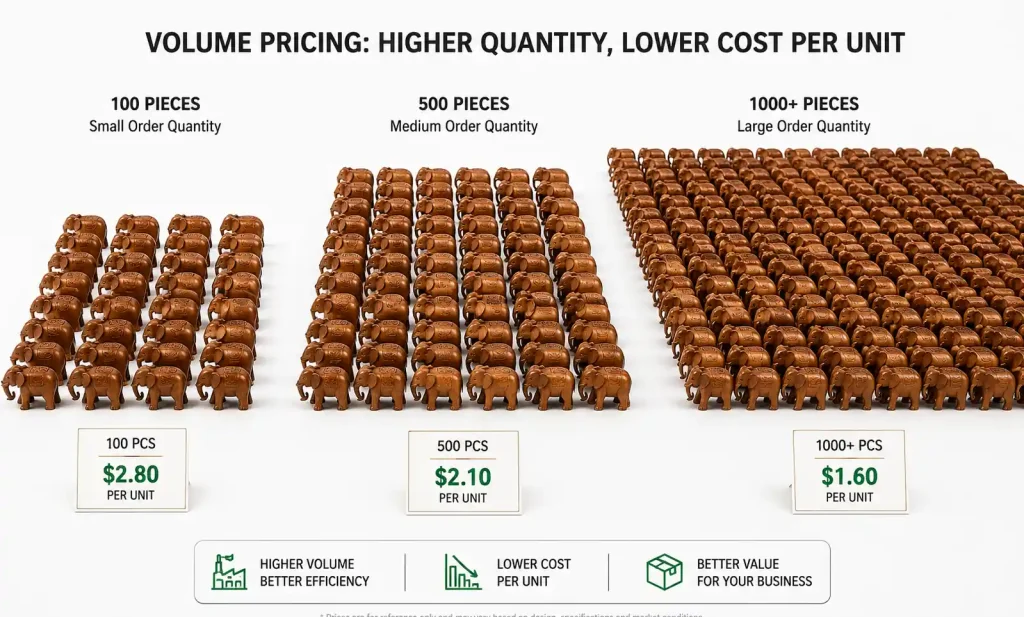
Volume pricing creates incentive for larger orders. Price breaks commonly occur at 500, 1,000, and 2,500 piece thresholds. A carving priced at $8.50 per unit for 200 pieces might drop to $7.20 at 500 pieces and $6.50 at 1,000 pieces as setup costs distribute and production efficiency increases.
Payment Terms: Standard terms require 30–40% deposit upon order confirmation, with the balance due before shipment. The deposit covers material procurement and production setup. Established buyers with proven payment history may negotiate net-30 or net-60 terms. Letters of credit suit large transactions, providing security for both parties.
Shipping, Packaging, and Final Delivery
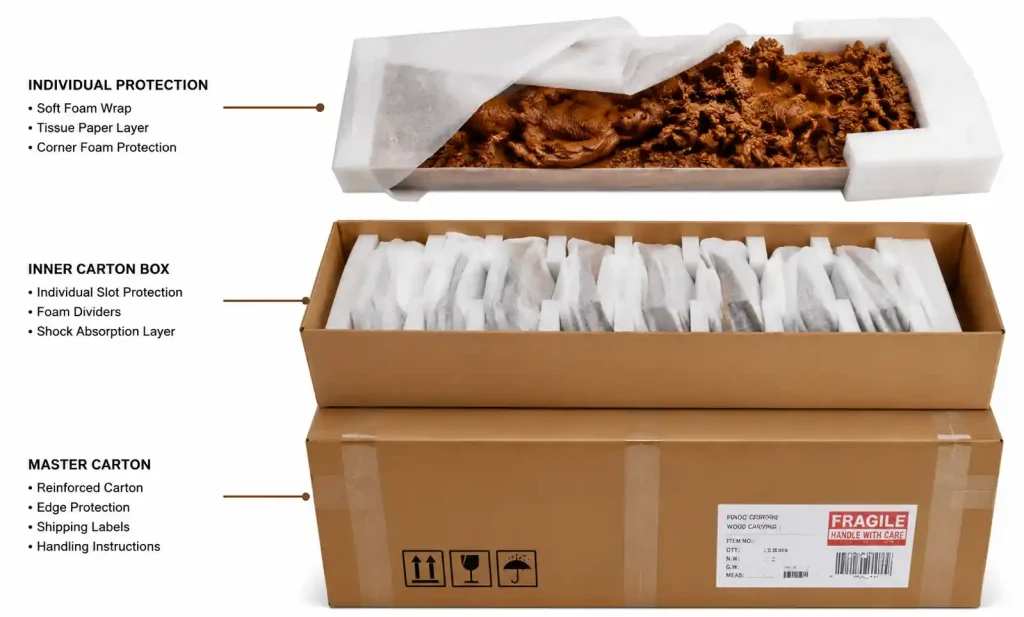
Proper packaging protects your investment during international transit. Wood carvings face risks from impact damage, moisture exposure, and temperature fluctuations. Professional manufacturers implement multi-layer packaging strategies combining individual wrapping, cushioned cartons, and reinforced master boxes.
Individual Protection: Pieces typically receive tissue paper or foam wrapping, protecting surfaces from scratches while allowing inspection without unwrapping. Delicate protruding elements like animal horns, sword tips, or thin decorative features receive extra padding or protective caps preventing breakage.
Inner Cartons: Group items in manageable quantities, typically 6–24 pieces depending on size. These boxes use corrugated cardboard rated for international shipping, with thickness (flute size) matched to product weight and fragility. Manufacturers often print product information, quantity, and handling instructions on inner cartons facilitating warehouse management.
Master Cartons: Consolidate inner boxes for palletization. These heavy-duty boxes feature reinforced corners and edges, bearing weight of stacked pallets during container transit. Proper master carton sizing optimizes container utilization: standard 20-foot and 40-foot containers accommodate specific pallet configurations, and efficient packing maximizes pieces per shipment, reducing per-unit freight costs.
Shipping Method Selection:
| Shipping Method | Transit Time | Cost | الأفضل لـ |
|---|---|---|---|
| Sea freight (LCL) | 4–6 weeks | $$ | Medium-large orders, cost-sensitive |
| Sea freight (FCL) | 4–6 weeks | $$$ | Large orders, full container |
| Air freight | 5–10 days | $$$$ | Rush orders, high-value items, samples |
Customs Compliance:
- Commercial invoices must declare product descriptions, material composition, country of origin, and declared value
- HTS codes classify goods for duty assessment. Wood products typically fall under chapter 44
- US import duty on wooden decorative articles: 0–6% depending on specific classification
- EU VAT often 15–25% of declared value plus duties
- ISPM 15 governs wood packaging materials for international trade — packaging must be treated and marked
Incoterms: DDP (Delivered Duty Paid) or DAP (Delivered at Place) options simplify importing for smaller retailers — the factory handles delivery and duties.
How to Verify a Wood Carving Manufacturer Before You Order
This is the most critical step in the sourcing process — and the one most buyers skip. Here’s a practical verification framework:
Step 1: Verify Business Legitimacy
- Cross-check business licenses via official registries like China’s AIC (Administration for Industry and Commerce)
- Request company registration documents and verify the physical factory address (not just a trading office)
- Use Google Maps or Baidu Maps to confirm the factory location exists
Step 2: Assess Production Capability
- Verify whether the manufacturer possesses in-house production tools — CNC routers, laser engravers, hand-finishing stations
- Ask for video walkthroughs of the actual production floor (not marketing videos)
- Request photos of work-in-progress (WIP) showing multiple stages of production
- Confirm artisan count and experience levels
Step 3: Review Quality Systems
- Request quality control documentation and defect rate statistics for similar products
- Ask about their inspection process: who performs inspections, at what stages, and what are the acceptance criteria
- Request references from buyers who have ordered similar products
Step 4: Order a Sample First
- Never commit to full production without physical samples
- Test samples for: dimensional accuracy, finish quality, wood stability, packaging durability
- Order samples shipped via the same method you’ll use for production to test packaging integrity
Red Flags to Watch For:
- Reluctance to provide factory video or photos
- Vague answers about production capabilities
- No quality control documentation
- Pressure to skip sampling and go directly to production
- Prices significantly lower than competitors (quality will suffer)
الأسئلة الشائعة
What is the typical minimum order quantity for custom wood carvings?
MOQ typically ranges from 100 to 1,000 pieces depending on design complexity and whether you choose OEM or ODM. Simple ODM designs from existing catalogs may accept 100–200 piece minimums, while complex OEM projects requiring custom tooling often require 500–1,000 pieces to justify setup costs. Discuss specific minimums during initial inquiries, as some manufacturers offer flexibility for first orders or long-term partnerships.
How long does the complete process take from design to delivery?
Expect 8–14 weeks total for OEM projects including sampling, production, and international shipping. ODM projects using existing designs may complete in 6–10 weeks. The timeline breaks down approximately as: design review (1–2 weeks), sampling and approval (2–4 weeks), production (2–8 weeks depending on quantity and complexity), and shipping (3–6 weeks for sea freight, 5–10 days for air). Plan accordingly for seasonal launches or specific market windows.
Can I request samples before committing to a full production order?
Yes. Manufacturers typically produce samples before production, particularly for OEM projects. Initial samples may be provided free or at nominal cost deducting from the production order, while elaborate OEM prototypes requiring significant development work might incur sampling fees of $100–500. These fees often credit toward production orders. ODM samples from existing catalogs usually ship quickly at minimal cost.
What certifications should I request for wood products?
Request FSC or PEFC certification confirming sustainable forestry practices, particularly important for European and environmentally conscious markets. For certain species, verify CITES compliance ensuring legal harvest and trade. For products with food contact (serving boards, utensils), request food-safe finish certifications. If selling in specific markets, confirm packaging meets ISPM 15 requirements.
How do payment terms typically work?
Standard terms require 30–40% deposit upon order confirmation, with the balance due before shipment. The deposit covers material procurement and production setup, while balance payment releases finished goods. Established buyers with proven payment history may negotiate net-30 or net-60 terms. Large transactions sometimes use letters of credit providing security for both parties through bank guarantees.
What happens if products arrive damaged or don’t meet specifications?
Reputable manufacturers provide recourse for defective goods. Document any damage or quality issues immediately with photographs and detailed descriptions. Manufacturing defects typically warrant replacement or credit, while shipping damage falls under freight insurance claims. Establish clear quality standards during sampling, maintaining approved samples as reference. Include quality acceptance criteria and remedy procedures in purchase agreements to prevent disputes.
Can designs be modified after sampling but before full production?
Yes. Design modifications between sampling and production are common, though they may affect timeline and pricing. Minor adjustments to dimensions, surface finish, or decoration details usually accommodate easily. Significant structural changes requiring new carving approaches or tooling may incur additional setup costs and extend timelines. Communicate all desired changes clearly before production begins to avoid misunderstandings.
How can I protect my proprietary OEM designs?
Include confidentiality and exclusivity clauses in purchase agreements preventing manufacturers from producing your designs for other buyers. Some buyers request signed non-disclosure agreements (NDAs) before sharing detailed specifications. While enforcement across international borders presents challenges, working with established manufacturers who value long-term relationships provides practical protection, as they depend on reputation and repeat business.
How do I verify a manufacturer before ordering?
Cross-check business licenses via official registries, request video walkthroughs of the actual production floor, verify in-house production capabilities, review quality control documentation, and always order physical samples before committing to full production.
الخلاصة
Successfully navigating OEM and ODM wood carving manufacturing requires understanding the complete process, from design development through material selection, production management, and international logistics. The investment in proper planning, clear communication, and quality-focused partnerships pays dividends in product excellence and market success.
Key Takeaways:
- Choose OEM for exclusivity and brand protection — but budget for longer timelines and higher MOQs
- Choose ODM for faster market entry and lower risk — but verify whether designs are exclusive
- Material selection drives cost, durability, and market positioning — match species to your target price point and application
- Always order physical samples before production — photos cannot convey wood texture, weight, or finish quality
- Verify manufacturers before you order — check licenses, request factory videos, review quality documentation
- Plan for 6–14 weeks total timeline — add buffer for seasonal disruptions (Chinese New Year, peak seasons)
- Factor import duties and VAT into landed cost — US duties 0–6%, EU VAT 15–25%