




Come trovare un produttore di braccialetti flessibili con perline di legno che offra opzioni con quantità minime d'ordine ridotte (2026)
Finding a wooden bead bracelet manufacturer that accepts low minimum orders can make or break a small jewelry business. Many suppliers won’t touch orders under 500 pieces per design, which ties up cash and creates inventory risk. This guide covers how to find manufacturers with genuine low-MOQ flexibility, what to look for in quality, and how to avoid common sourcing mistakes.
Why Low MOQ Matters for Small Jewelry Brands
Traditional manufacturers typically require 500–1,000 pieces per design. That means tying up thousands of dollars in a single style before knowing if it sells. Low-MOQ manufacturers (50–200 pieces) let you test multiple designs, respond to trends, and manage cash flow. You can also run limited editions and exclusive drops without sitting on dead stock. For small retailers, this flexibility is survival.
How MOQ Structures Work
Manufacturers structure minimums differently. Understanding the variations helps you negotiate.
Fixed MOQ per design: You must order a minimum quantity of each style. Three designs × 100 pieces each = 300 total. Best when you want depth in specific SKUs.
Flexible MOQ across designs: You can mix styles to hit the total minimum. 200 pieces total could be 50 each of four designs. This gives variety while meeting production requirements.
Tiered pricing: Per-unit cost drops as quantity increases. 50 pieces might cost $3.50 each, 100 pieces $2.80, 200 pieces $2.20. The savings flatten out after a certain point—usually around 300–500 pieces.
| MOQ Structure | Order Flexibility | Ideale per | Typical Range |
|---|---|---|---|
| Fixed per design | Low—must hit minimum for each style | Focused lines, proven sellers | 100-300 pieces |
| Flexible mixed order | High—combine multiple designs | Boutiques, variety-focused retailers | 50-200 total pieces |
| Tiered pricing | Scales with volume | Growing businesses | 50-500+ pieces |
| Sample/trial order | Very high—test before commitment | New partnerships, product testing | 10-50 pieces |
If you’re just starting out, prioritize suppliers that offer samples or flexible mixed orders. Don’t lock into a fixed-per-design MOQ until you know which styles actually sell.
Evaluating a Manufacturer: Beyond MOQ
MOQ is important, but don’t let it be the only factor. Here’s what else matters.
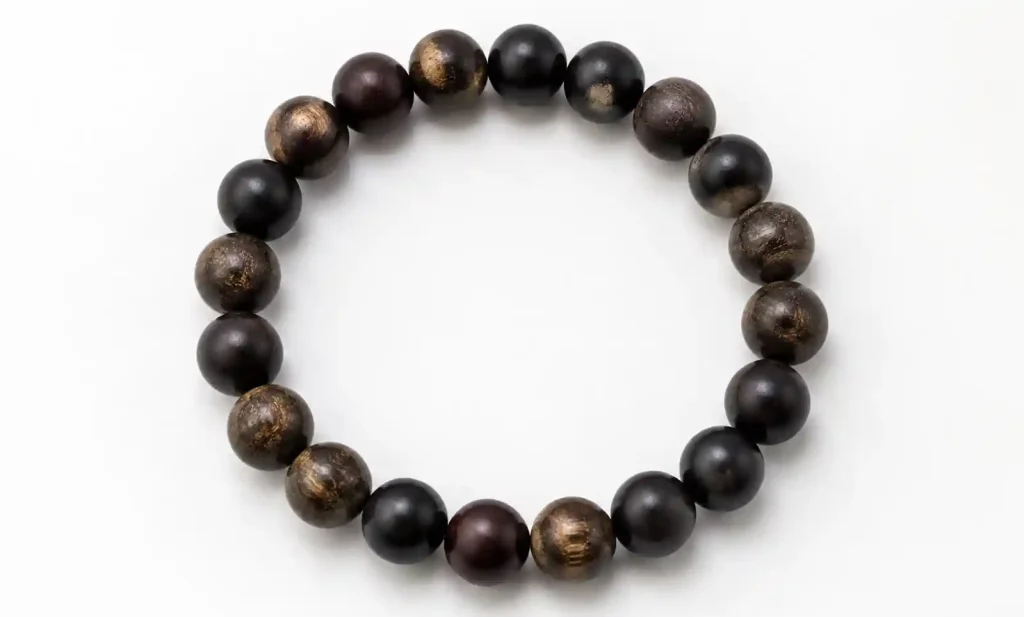
Material sourcing: Ask where the wood comes from. Quality beads use hardwoods like sandalwood, rosewood, teak, or ebony—preferably FSC-certified. Natural wood varies in grain and color. A good manufacturer manages these variations consistently so your orders look uniform.
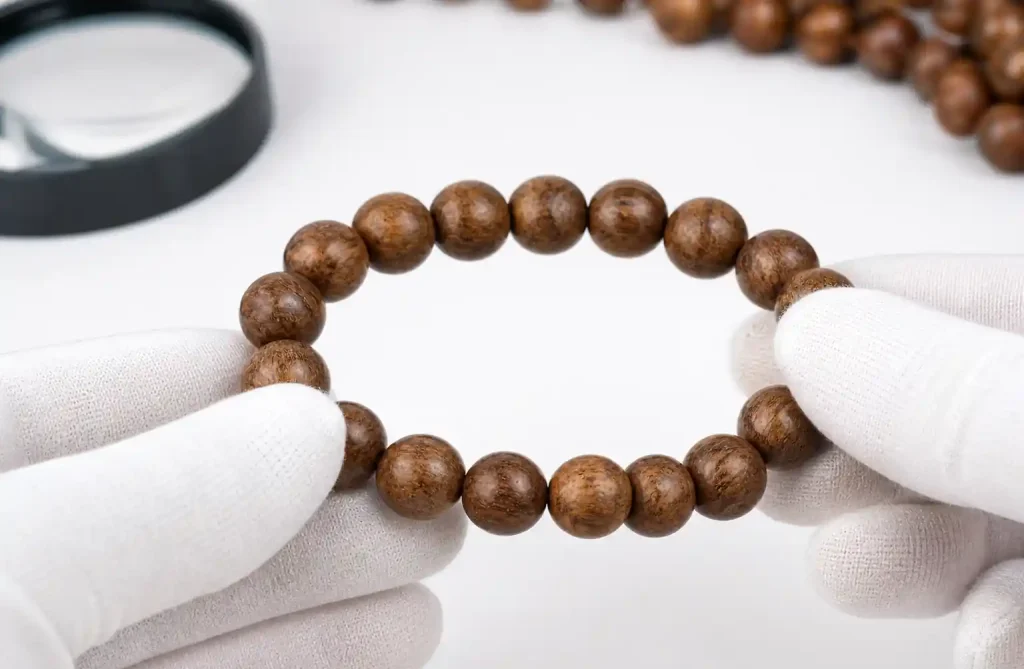
Production capabilities: Some workshops only do simple uniform beads. Others offer carved beads, mixed materials, or complex patterns. Check their catalog. If your brand does rustic boho styles and they only do sleek modern designs, it’s probably not a fit.
Communication speed: When you’re placing smaller orders, you’re not their top priority. Test responsiveness before ordering. If they take 3 days to reply to an inquiry, expect worse during production.
Quality control: Ask about defect rates and how they handle quality issues. Good manufacturers photograph finished orders before shipping and replace defective pieces without argument.
Customization options: Can they add metal accents? Adjust bead sizes? Do custom packaging? These services add value without requiring you to coordinate multiple vendors.
Manufacturer Types and MOQ Trade-Offs
| Type | Typical MOQ | Customization | Lead Time | Price | Ideale per |
|---|---|---|---|---|---|
| Large factory | 500-2,000 pcs | Limited—set designs | 30-45 days | Lowest ($1.50-$3.00) | Bulk orders, established retailers |
| Mid-size workshop | 100-500 pcs | Moderate—some modifications | 20-35 days | Mid ($2.50-$5.00) | Growing businesses, semi-custom work |
| Small artisan studio | 50-200 pcs | High—full customization | 15-30 days | Premium ($4.00-$8.00) | Boutiques, unique designs |
| Dropship/white label | 1-50 pcs | Very limited—catalog only | 7-15 days | Highest ($5.00-$12.00) | Testing, cash-flow-constrained businesses |
Large factories give the best unit price but lock you into big orders. Mid-size workshops are the sweet spot for most small-to-medium retailers—they offer reasonable MOQs, decent customization, and competitive pricing. Small artisan studios are for signature pieces and limited editions where quality and uniqueness justify the cost. Dropshippers are convenient but margins are thin.
What to Check in Samples
Quality evaluation starts with samples. Spend the $20–50 to get them.
Bead consistency: Roll beads between your fingers. They should feel uniform. Irregular sizing creates a lumpy look and suggests rushed production.
Finish: Run your finger along the surface. No rough spots, splinters, or uneven coating. Thick, glossy finishes often hide low-quality wood underneath.
Stringing: The elastic should be durable, properly sized for the bead holes, and well-knotted. Cheap elastic breaks within weeks. Good manufacturers use multi-strand elastic or waxed cord.
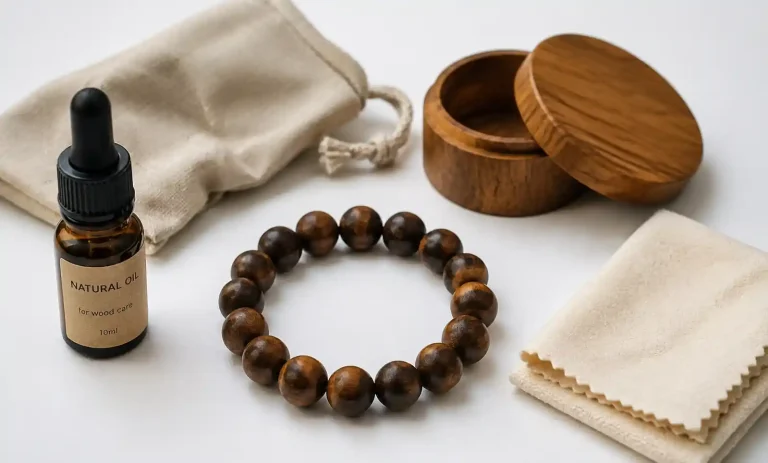
Wood authenticity: Real sandalwood has a distinctive sweet woody scent. Fake sandalwood smells like cheap perfume or nothing. Rosewood shows natural grain variation; stained imitations look artificially uniform. For premium woods, ask for certificates of authenticity.
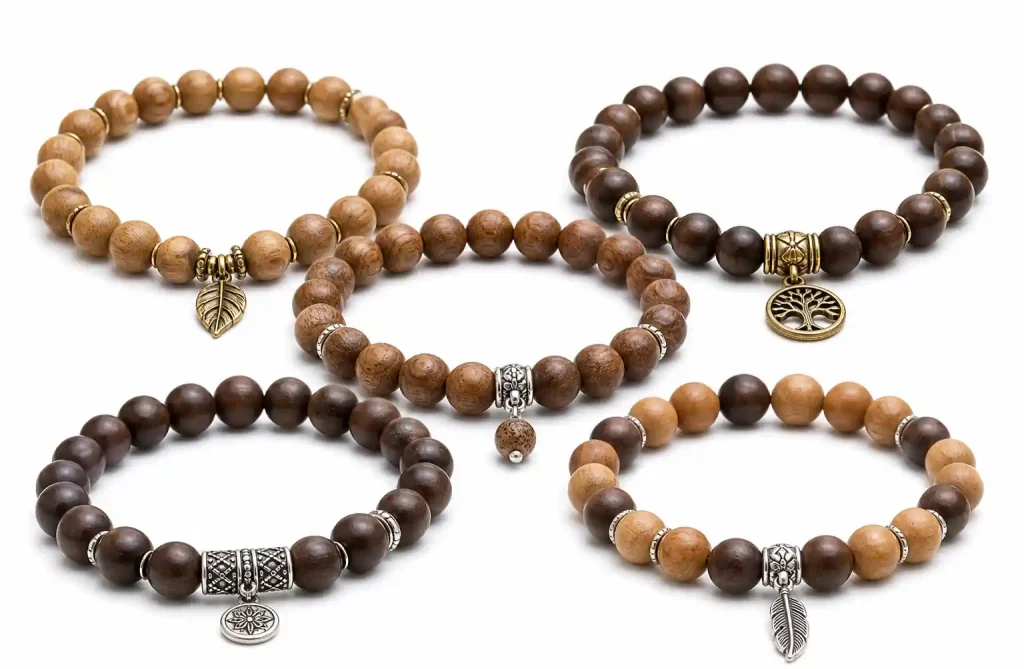
Metal parts: If the bracelet has spacers, charms, or clasps, they should resist tarnishing and feel solid. Cheap metal immediately drags down perceived quality.
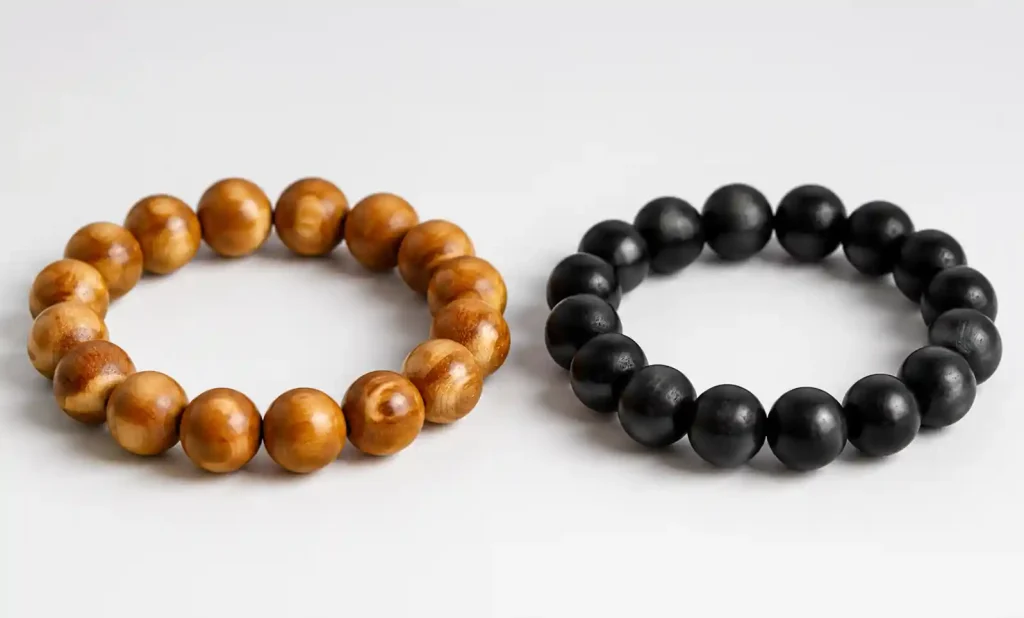
Customization Options That Don’t Require Higher MOQs
You can add perceived value without pushing up minimums.
Bead size variations: Offering the same design in 6mm, 8mm, and 10mm usually doesn’t increase MOQ. Most manufacturers accommodate size changes within the same order minimum.
Wood type substitutions: Swapping maple for walnut, or changing from one dark wood to another, typically doesn’t require a higher MOQ. Upgrading to premium woods like sandalwood or rosewood might, due to material costs.
Simple pattern mixing: Alternating two wood types or adding an accent bead color generally doesn’t affect MOQ. Complex multi-color sequences might.
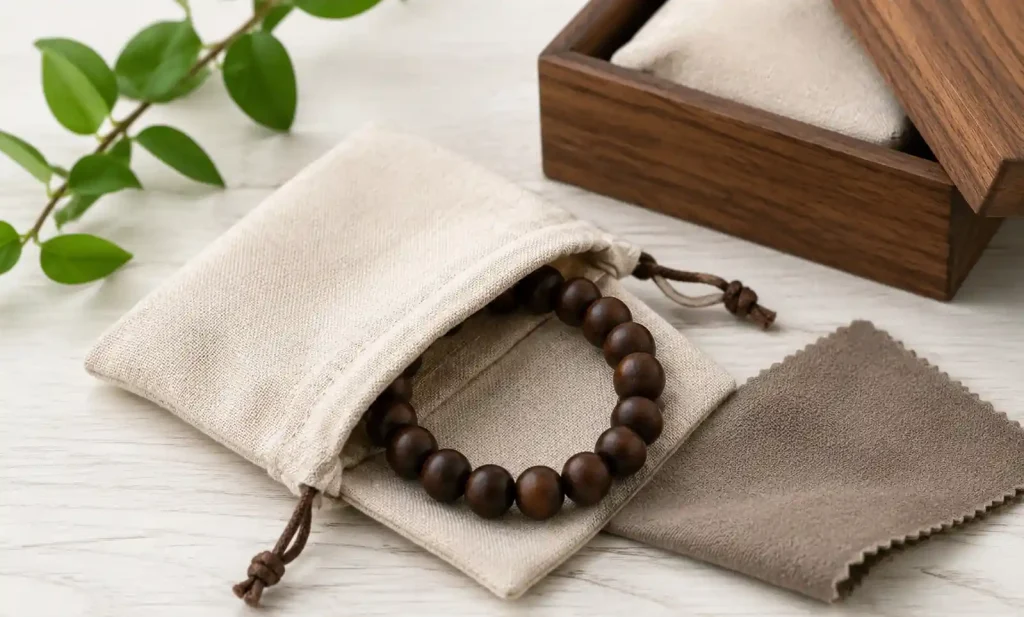
Packaging: Custom pouches, branded boxes, and information cards differentiate your product without affecting bracelet MOQs. Packaging usually has its own lower minimums—often 100–200 pieces.
Small metal charms: A stamped logo charm or meaningful symbol creates brand recognition. These typically require 100–200 piece minimums but can be used across multiple designs.
Building Supplier Relationships for Better Terms
The first order is just the start. Manufacturers get more flexible as trust builds.
Start small, even if you can afford more. It shows you’re professional—you’re validating quality before scaling—and gives you leverage for better terms later. Pay on time, every time. After a few successful orders, many manufacturers offer extended payment terms, reduced deposits, or pricing discounts.
Share forecasts. If you tell them you’ll need holiday inventory in August, they can plan production and potentially offer better pricing because your order fits their schedule.
Red Flags to Watch For
Prices way below market: If everyone quotes $3.50 and one supplier offers $1.50, something is wrong. You’ll get inferior materials, short quantities, or hidden fees.
Vague answers about materials or processes: If they can’t clearly explain where their wood comes from or how they control quality, move on.
No sample policy: Legitimate manufacturers provide samples because they know quality sells itself. Reluctance to send samples is a bad sign.
Pushing for full payment upfront: Standard is 30-50% deposit, balance before shipping. Full payment upfront puts you at risk.
No production verification: Ask for facility photos, certifications, or customer references. If they won’t provide any, assume they can’t.
Domande frequenti
What is the typical MOQ range for wooden bead bracelets from Chinese manufacturers?
Most manufacturers require 100-500 pieces for standard designs. Smaller workshops accept 50-100 pieces, especially for mixed orders. Sample orders of 10-30 pieces are often available at higher per-unit costs.
How much should I expect to pay per bracelet at different order quantities?
For standard 8mm wooden bead bracelets in common materials: $4-$6 at 50 pieces, $3-$4.50 at 100 pieces, $2.50-$3.50 at 200+ pieces. Premium woods like sandalwood add 30-80%.
Can I mix different designs within one order to meet MOQ requirements?
Many small to mid-size manufacturers allow mixed designs within a single order. Confirm the policy—some require each design to hit its own minimum.
How long does production take for low MOQ orders?
15-35 days after sample approval and deposit. Smaller quantities may ship faster but can wait behind larger orders. Add 7-15 days for shipping. Rush production costs 20-40% extra.
What certifications should I look for?
FSC for sustainable wood, ISO 9001 for quality management, BSCI or Sedex for ethical practices. Not all small manufacturers hold every certification, but they should provide material safety documentation.
How can I verify the authenticity of premium woods?
Real sandalwood has a distinct long-lasting sweet woody scent. Rosewood shows natural grain variation and rich multi-toned coloring. Request material certificates or third-party test reports. Physical samples are the most reliable verification.
What payment terms are standard for first-time orders?
30-50% deposit to start production, balance before shipping. Methods include wire transfer (T/T), PayPal (for smaller orders), or trade assurance platforms. Avoid suppliers demanding 100% upfront.
Should I use a sourcing agent or work directly with manufacturers?
Direct gives better pricing and clearer communication but takes more time for verification. Agents add 5-15% but provide quality control, factory verification, and communication support—valuable for first-time importers.
Conclusione
Finding a flexible low-MOQ wooden bead bracelet manufacturer comes down to balancing quality, price, communication, and production capabilities against your business needs. Start with samples to verify quality. Prioritize suppliers whose production strengths align with your designs and whose communication style matches your expectations.
The right manufacturer becomes a growth partner—offering better terms over time, suggesting new designs, and scaling with your business. A supplier with rock-bottom pricing but poor quality or responsiveness will cost you more in lost sales than you save on unit costs.
For retailers and small businesses seeking a reliable wooden bead bracelet manufacturer with genuine low MOQ flexibility, experienced Chinese manufacturers who specialize in customizable wooden jewelry products offer competitive pricing, diverse material options, and production expertise built over years of serving international markets.