




Understanding the Moisture Content in Wood: How We Prevent Cracking in Global Shipping
When you invest in a handcrafted wood carving, you’re bringing home a living material that responds to its environment. One of the most critical factors in ensuring your piece arrives intact and stays beautiful is proper moisture management. At Fine Wood Art, we’ve spent years refining our approach to moisture control through expert wood working techniques so that every piece we ship worldwide maintains its integrity regardless of destination climate.
Wood cracking during or after shipping is one of the most common concerns among international buyers. The good news? With proper understanding and preventive measures, it’s entirely avoidable. This guide explains the science behind wood moisture content, how environmental changes affect carvings, and the steps we take to protect your investment throughout its journey.
Why Moisture Content Matters in Wood Carvings
Wood is hygroscopic – it naturally absorbs and releases moisture to reach equilibrium with its surroundings. When a carving hits rapid humidity changes – say, shipping from a humid subtropical workshop to a dry continental climate – internal stresses develop as the wood adjusts. These stresses show up as surface checks, deep cracks, warping, or splitting along the grain.
For handcrafted wooden art, moisture content directly impacts dimensional stability, structural integrity, surface finish quality, and long-term durability. Unlike mass-produced items, artisan carvings have intricate details, varying grain patterns, and natural characteristics that make them particularly sensitive to moisture fluctuations.
Global shipping makes this tougher. A carving might travel from a workshop at 70-80% relative humidity, through climate-controlled containers, into warehouse storage at 40% humidity, and finally to a home with centrally heated air at 25% humidity – all within two to three weeks. Without proper preparation, that journey can be devastating.
Understanding Wood Moisture Content Levels
Wood moisture content (MC) is expressed as a percentage – weight of water in wood relative to its oven-dry weight. Fresh-cut or “green” wood can run 40% to 200% or more, depending on species. For carvings intended for indoor use, the target is much lower and varies by destination climate.
The concept of equilibrium moisture content (EMC) is key. This is the moisture level at which wood neither gains nor loses moisture to its environment. When internal MC differs significantly from the EMC of the environment, wood shrinks or swells to reach equilibrium – and that movement causes cracking.
In tropical and subtropical regions, wood naturally stabilizes at 12-16% MC. In temperate climates, the ideal range is 8-12% MC. In arid regions or heated indoor environments during winter, wood should be at 6-8% MC. Central heating and air conditioning can push indoor environments to extremely low relative humidity, sometimes requiring wood to stabilize as low as 4-6% MC.
Our approach starts with understanding not just where the wood begins, but where it’s going. Before any carving project for international clients, we consider the destination climate and pre-condition the wood accordingly.
The Science Behind Wood Cracking
Understanding why wood cracks explains our prevention strategy. Wood is made of tubular cells running along the grain. These cells absorb moisture primarily through their walls, causing expansion perpendicular to the grain while expanding minimally along the grain length.
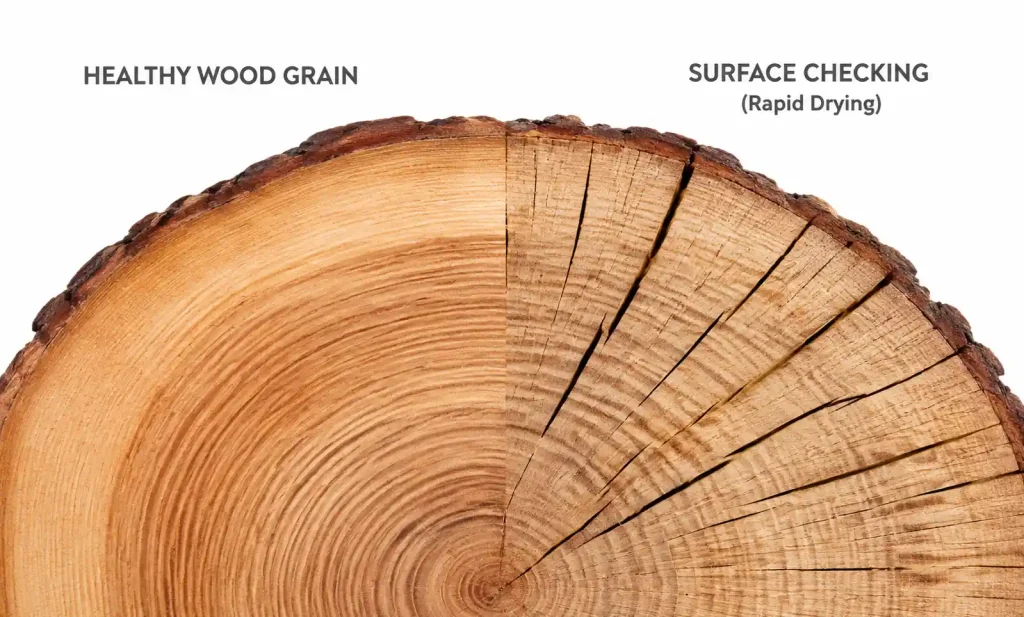
When wood dries too fast, the surface loses moisture quicker than the interior. This creates differential shrinkage – outer layers want to contract while the interior stays expanded. The resulting tension exceeds the wood’s tensile strength perpendicular to the grain, causing surface checking or deep radial cracks.
Different species show varying degrees of movement and cracking susceptibility. High-density woods with interlocked grain or high tannin content tend to be more stable. Species with wide growth rings, straight grain, or low density are more prone to movement and checking.
The rate of moisture change matters as much as the total change. Wood can adapt to significant moisture differences if the transition happens gradually over weeks or months. Rapid changes over days create the stress that causes damage.
Our Comprehensive Moisture Control Process
Moisture management starts long before carving. Our process has four stages: wood selection and sourcing, controlled drying and stabilization, carving with moisture monitoring, and pre-shipment conditioning.
Stage 1: Wood Selection and Initial Drying – We source wood air-dried for a minimum of 12-24 months, depending on thickness and species. Air drying reduces moisture naturally and gradually, minimizing internal stress. For premium pieces, we use wood air-dried for 2-3 years. After air drying, selected wood enters our kiln-drying facility where we reduce moisture to target levels using carefully controlled schedules over 2-4 weeks.
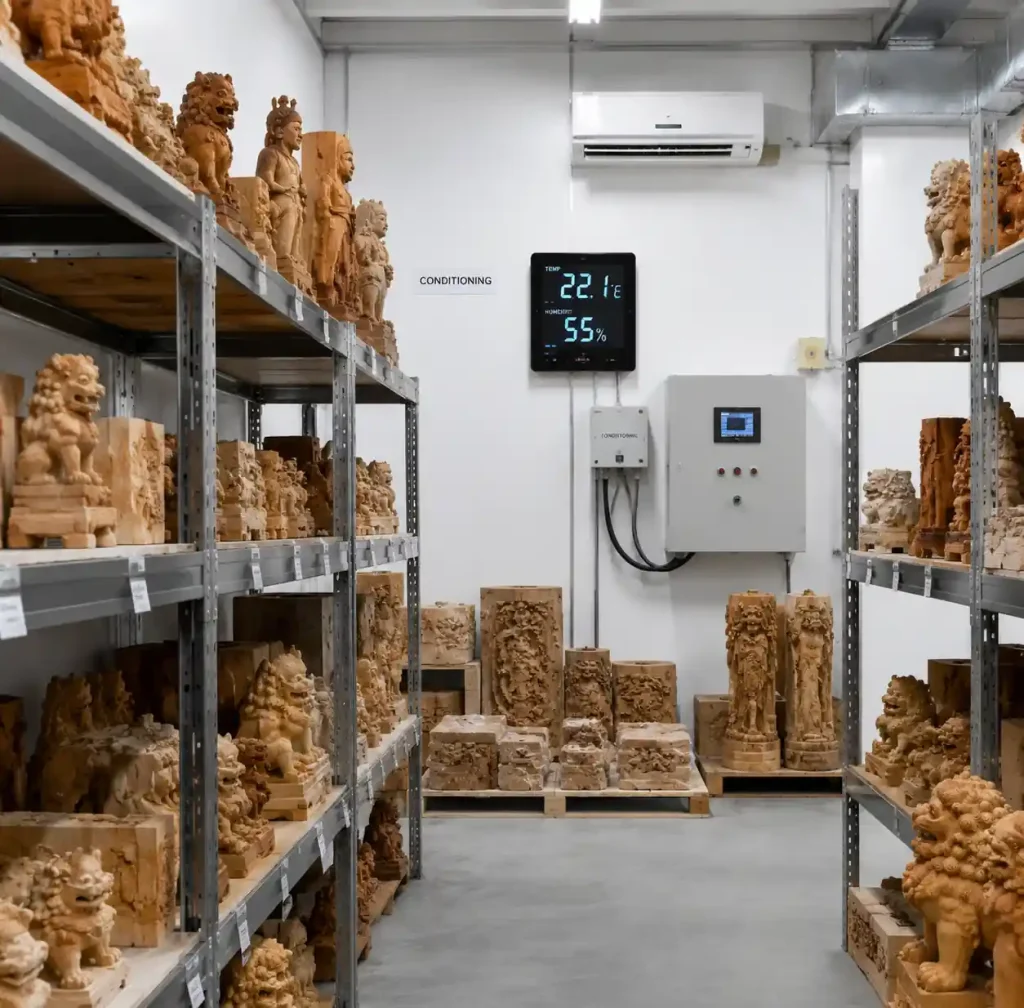
Stage 2: Acclimation and Monitoring – Before carving begins, wood rests in our workshop for 4-8 weeks. We monitor moisture content weekly using pin-type and pinless moisture meters. Wood is only released for carving when readings show consistent stability at target levels. For carvings destined for particularly dry climates, we pre-condition wood in controlled low-humidity chambers to bring MC down to 6-8% before carving starts.
Stage 3: Carving with Moisture Awareness – Our artisans monitor moisture throughout the carving process. As wood is carved, newly exposed interior surfaces may release moisture. Partially completed carvings rest periodically to allow moisture redistribution and stabilization. Complex carvings with varying thicknesses get special attention – we sometimes hollow out thick areas from the back to promote uniform drying and reduce core splitting risk.
Stage 4: Pre-Shipment Conditioning – Once carving is complete, pieces undergo final conditioning for 2-4 weeks in an environment that mimics the destination climate. We use climate data for major shipping destinations to set appropriate temperature and humidity levels. During this period, we apply protective finishes that help stabilize moisture exchange rates – natural oils, waxes, and lacquers create a semi-permeable barrier that slows moisture movement, allowing gradual adaptation.
Material-Specific Moisture Requirements
Different wood species need distinct moisture management approaches.
| Wood Species | Ideal Moisture Content | Stability Rating | Shipping Considerations |
|---|---|---|---|
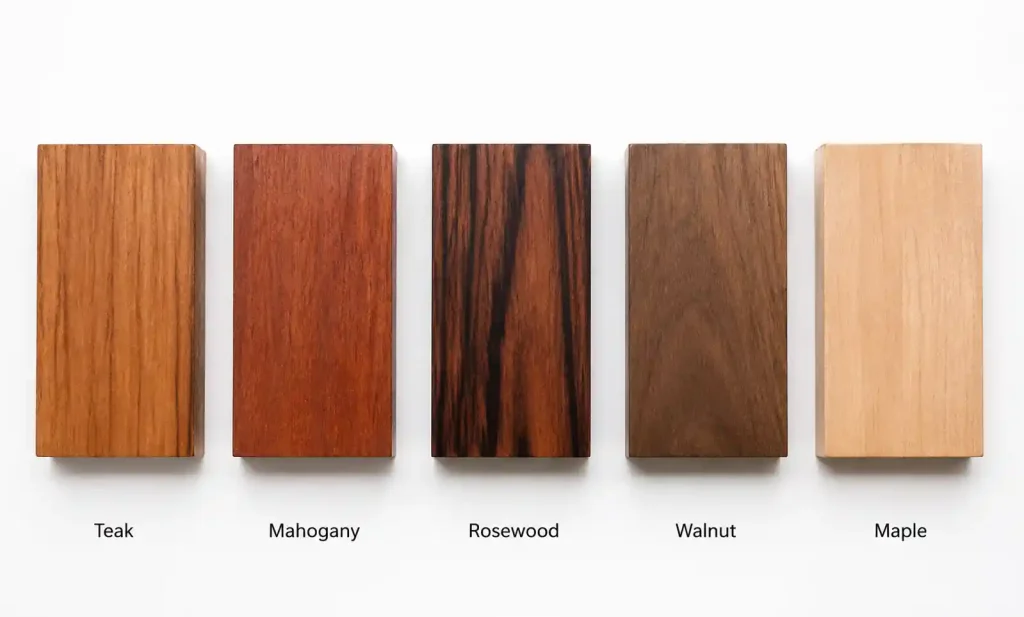
| Teak | 8-12% MC | Eccellente | Natural oils provide inherent stability; minimal cracking risk |
| Mogano | 7-10% MC | Very Good | Stable with fine, even grain; responds well to gradual conditioning |
| Legno di palissandro | 6-9% MC | Bene | Dense with high oil content; requires longer conditioning |
| Legno di sandalo | 7-11% MC | Bene | Aromatic oils aid stability; smaller pieces adapt faster |
| Ebony | 6-8% MC | Moderate | Extremely dense; slow moisture exchange; requires extended conditioning |
| Cedar | 8-12% MC | Bene | Lightweight and naturally stable; good for larger pieces |
| Noce | 7-10% MC | Very Good | Even density and fine grain; predictable movement |
Beyond species, we consider grain orientation and natural features. Carvings with exposed end grain get additional surface sealing – end grain absorbs and releases moisture 10-15 times faster than side grain. Pieces with included bark, natural edges, or spalting receive extra conditioning time.
Packaging and Shipping Protection Methods
Even perfectly conditioned wood needs protection during shipping. Our packaging creates a stable microenvironment that buffers against rapid environmental changes.
Protective Finishing – Before packaging, all surfaces receive appropriate finishes. For most carvings, we apply multiple coats of natural tung oil or Danish oil, which penetrates deeply while allowing controlled moisture exchange. For high-gloss pieces, catalyzed lacquer provides a more substantial barrier. These finishes regulate the rate of moisture exchange rather than completely sealing the wood.
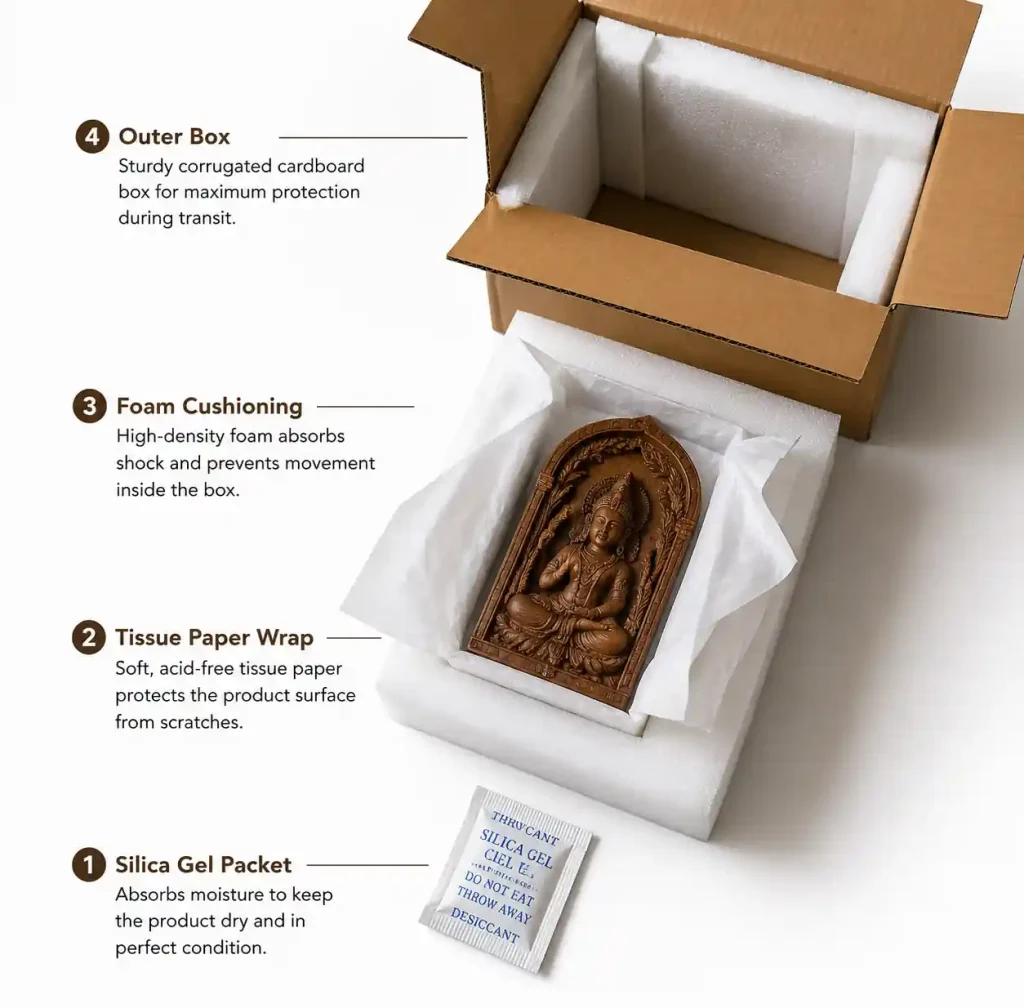
Multi-Layer Packaging – Inner wrap uses acid-free tissue paper for surface protection without creating a vapor barrier. A cushioning layer of foam or biodegradable packing peanuts provides impact protection and insulation. Silica gel packets stabilize humidity within the package. The outer carton uses double-wall corrugated cardboard for structural protection.
| Packaging Method | Ideale per | Protection Level | Cost | Lead Time |
|---|---|---|---|---|
| Standard Multi-Layer | Small to medium carvings, stable climates | High | Standard | 2-3 days |
| Climate-Controlled + Enhanced | Large pieces, extreme climate differences | Very High | +25% | 3-4 weeks |
| Museum-Grade Packaging | High-value pieces, antique reproductions | Exceptional | +50% | 4-6 weeks |
We recommend choosing packaging level based on carving value, species stability, and climate difference rather than simply picking the cheapest option. A cracked carving costs far more than premium packaging. For collectors of fine wood art, understanding these principles is key – and high-quality wooden collectibles are increasingly recognized as investment-worthy pieces with lasting value beyond just decor.
Domande frequenti
What is the ideal moisture content for wood carvings in my home?
For most indoor environments, wood carvings stabilize at 8-12% moisture content, corresponding to 40-55% relative humidity at typical room temperature. In dry climates or during winter heating, wood may drop to 6-8% MC. We pre-condition wood to match expected destination conditions, so your carving should arrive already at or near ideal levels. Using a room humidifier during dry winter months helps maintain stable conditions.
What should I do if I notice cracks appearing after delivery?
First, assess the crack type. Fine surface checks (hairline cracks visible on the surface but not extending deeply) are often normal adaptation and don’t compromise structural integrity. Deep cracks, splits extending across the piece, or structural separations need attention. Contact us immediately with photos if you observe concerning cracks. Move the carving to a more moderate humidity environment, apply additional protective oil or wax, and avoid handling until we assess the situation.
Are certain wood species more resistant to cracking than others?
Yes, significantly. Teak, mahogany, and walnut are among the most stable species with excellent resistance to checking and splitting. Rosewood and sandalwood have natural oils that provide good stability, particularly in smaller pieces. Dense tropical hardwoods generally handle moisture changes better than temperate softwoods. We always recommend species selection based on your climate and display environment, especially for large investment pieces.
Can wood carvings be displayed in bathrooms or other high-humidity areas?
We generally don’t recommend displaying wood carvings in bathrooms, laundry rooms, or other areas with frequent high humidity and temperature fluctuations. However, certain stable species like teak can tolerate higher humidity if it remains relatively constant. Avoid locations with dramatic cyclical changes – daily swings from steamy to dry create stress. If you want wood decoration in these areas, choose smaller pieces of highly stable species with durable protective finishes.
What’s the difference between preventive conditioning and just sealing wood with thick finish?
Completely sealing wood with thick, impermeable finishes seems protective but actually creates problems. First, it’s nearly impossible to achieve complete sealing – any exposed end grain, joints, or finish imperfections become moisture entry points. Second, sealing traps existing moisture inside, which can cause internal stress and splitting if conditions change. Our approach uses breathable finishes that regulate moisture exchange rates rather than stopping it entirely, allowing gradual, stress-free adaptation.
Conclusione
Understanding wood moisture content comes down to treating wood as the natural, responsive material it is. From initial selection through conditioning to protective packaging, our process ensures your carving arrives ready to adapt to its new environment. When you choose a handcrafted piece, you’re investing in artisan skill and natural beauty – protecting that investment takes our preparation and your care. If you’re also exploring other wood art forms, our guide on decorazioni in legno personalizzate shows how similar quality principles apply across all wood decor. Browse our collection and reach out with questions about conditioning for your climate – we’re here to help every piece last.