





Cómo reconocer la artesanía de alta calidad en las réplicas de armas de madera al por mayor
When sourcing wholesale wooden weapon replicas—whether for retail inventory, film production, martial arts training, or collector markets—the difference between exceptional craftsmanship and mediocre work can make or break your investment. High-quality handcrafted wooden swords, daggers, and historical weapon replicas command premium prices and build customer loyalty, while poorly executed pieces lead to returns, complaints, and damaged reputation.
This guide equips buyers, retailers, and collectors with the knowledge to evaluate craftsmanship quality in wholesale wooden weapon replicas. You’ll learn to identify the hallmarks of skilled artisanship, understand material authenticity, recognize production shortcuts, and make informed purchasing decisions that protect your business and satisfy your customers.
1. Understanding Craftsmanship Fundamentals in Wooden Weapons
Quality craftsmanship in wooden weapon replicas begins with understanding the traditional techniques that have been refined over centuries. Authentic wooden swords, whether they’re European longswords, Japanese bokken, Chinese dao, or fantasy weapon designs, require specific knowledge of weight distribution, structural integrity, and ergonomic design.
Master craftsmen who specialize in wooden weapons understand that these pieces must balance aesthetic appeal with functional authenticity. Even decorative replicas benefit from proper weight balance and realistic proportions that honor the original weapon’s design. This attention to historical accuracy or design intent distinguishes professional work from mass-produced novelty items.
The craftsmanship hierarchy in wooden weapons typically falls into three categories: production-grade pieces made primarily by machine with minimal hand finishing, semi-custom pieces that combine machine work with significant hand detailing, and fully handcrafted replicas where skilled artisans shape, carve, and finish each piece individually. Understanding where your wholesale order falls on this spectrum helps set appropriate price expectations and quality standards.
When evaluating craftsmanship, consider the intended use. Training weapons require different structural qualities than display pieces. A bokken for martial arts practice needs superior grain alignment for impact resistance, while a decorative fantasy sword prioritizes intricate carving and visual drama. High-quality suppliers understand these distinctions and can provide appropriate specifications for each category.
2. Wood Selection and Material Quality Indicators
The foundation of any quality wooden weapon replica is the wood itself. Premium craftsmen select hardwoods with specific characteristics suited to weapon replication. Teak, oak, hickory, ash, and hard maple are traditional choices for functional training weapons due to their density and shock resistance. Mahogany, walnut, and rosewood offer rich colors and workability for decorative pieces.
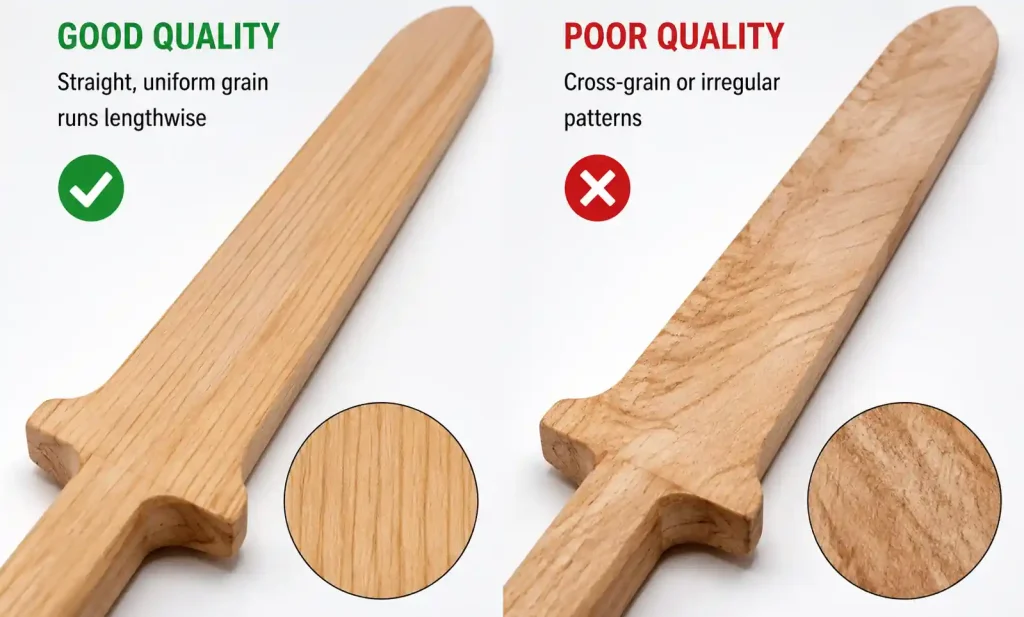
Grain orientation is critical. Quality wooden swords feature straight grain running the length of the blade, which provides maximum strength and prevents splitting under stress. Cross-grain or irregular grain patterns create weak points that compromise structural integrity. When inspecting wholesale samples, sight down the length of the blade—you should see consistent, straight grain lines without significant deviation.
| Tipo de madera | Características | Las mejores aplicaciones | Rango de precios |
|---|---|---|---|
| White Oak / Red Oak | Dense, shock-resistant, prominent grain | Training weapons, historical replicas | Mid-range |
| Hickory | Extremely strong, excellent flexibility | Functional practice weapons, staffs | Mid to high |
| Hard Maple | Dense, fine grain, light color | Training swords, decorative replicas | Mid-range |
| Teca | Weather-resistant, stable, golden-brown | Outdoor display, high-end decorative | Alto |
| Caoba | Rich color, easy to carve, moderate density | Decorative replicas, detailed carving | Mid-range |
| Palisandro | Exotic appearance, very hard, aromatic | Premium decorative pieces, collector items | Alto |
| Nogal | Beautiful dark color, moderate hardness | Display swords, gift items | Mid to high |
This material selection table guides your expectations for different price points and intended uses. Training weapons should never be made from soft woods like pine or poplar, regardless of how attractive the price may seem. These materials lack the structural integrity for safe use and indicate a supplier prioritizing cost over quality.
Moisture content matters significantly. Properly dried wood (typically 6-8% moisture content for indoor pieces) won’t warp, crack, or split after purchase. Quality suppliers kiln-dry their wood and allow it to stabilize before crafting. Ask potential wholesale partners about their wood preparation process—vague answers or dismissal of the question signals potential quality issues.
Look for wood that’s free from major defects. Small knots may be acceptable in decorative pieces if they’re incorporated into the design, but they’re unacceptable in functional training weapons. Cracks, checks, sapwood inclusions, or pitch pockets indicate either poor wood selection or inadequate drying processes.
3. Hand-Carved vs. Machine-Made: Identifying the Difference
The distinction between hand-carved and machine-made wooden weapons significantly impacts both price and quality. Understanding how to identify the production method helps you assess whether wholesale pricing aligns with actual craftsmanship level.
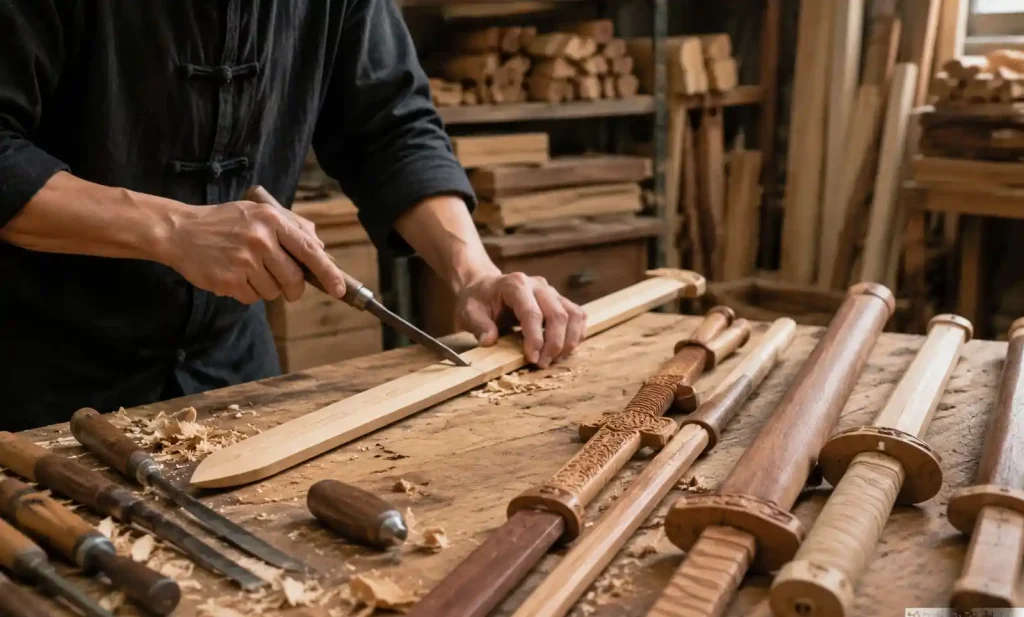
Hand-carved pieces display subtle irregularities that indicate human craftsmanship. Tool marks from chisels, gouges, and carving knives create texture variations that catch light differently across the surface. These aren’t flaws—they’re signatures of handwork. The carving depth and detail will vary slightly across repeated patterns, and symmetrical elements won’t be perfectly identical when measured precisely.
Machine-made replicas, produced on CNC routers or lathes, show perfect repetition and mathematical precision. Every detail matches exactly across multiple pieces. Surface texture appears uniform, and any decorative elements repeat with mechanical accuracy. While high-end CNC work can produce beautiful results, it lacks the character and subtle variations that collectors and discerning customers appreciate.
Many quality suppliers use a hybrid approach: machine tools rough out the basic shape efficiently, then skilled craftsmen hand-finish details, refine contours, and add unique elements. This method balances cost-effectiveness with artistic quality. When evaluating wholesale samples, ask specifically about the production process. Honest suppliers will clearly explain their methods.
To identify hand finishing, examine areas where precision is challenging—the transition between blade and guard, inside curves and recesses, the handle grip contouring. Hand-finished pieces show thoughtful detail work in these difficult areas, while purely machine-made pieces either avoid complex geometry or show telltale machine patterns like identical radius curves or visible tool path lines.
The handle wrap or grip treatment is particularly revealing. Hand-wrapped cord, leather, or textile grips show slight tension variations and organic securing methods. Machine or factory-applied wraps appear mechanically perfect with uniform spacing and identical angles at every cross-point.
4. Critical Quality Checkpoints for Wooden Weapon Replicas
When evaluating wholesale wooden weapon samples, systematic inspection across specific checkpoints ensures consistent quality standards. These evaluation criteria apply whether you’re assessing training weapons, decorative replicas, or collector pieces.
Weight and Balance: A quality wooden sword, regardless of type, should feel balanced in the hand. The balance point (center of percussion) should fall appropriately for the weapon style—typically 3-5 inches forward of the guard for European swords, closer to the guard for Asian blades. Poorly crafted pieces feel awkwardly heavy or tip-heavy, indicating incorrect proportions or inappropriate wood selection.
Structural Integrity: Gently flex the blade (only appropriate for training weapons, not decorative pieces). Quality construction allows slight flex with immediate return to true straightness. Excessive flexibility or permanent bending indicates weak wood or poor grain orientation. Check the tang (the portion extending into the handle)—it should run the full length with adequate thickness to prevent breakage at stress points.
Joinery and Assembly: For weapons with separate components (blade, guard, handle, pommel), examine how these elements connect. Quality pieces feature tight, stable joinery with no movement or gaps. Guards should fit snugly against the blade shoulder. Pommels should secure firmly without rattling. Visible gaps or loose fittings indicate rushed assembly or poor craftsmanship.
Proportional Accuracy: Compare the replica dimensions against historical references or original design specifications. Length, blade width, taper rate, and thickness should follow appropriate proportions. Disproportionate elements—overly thick blades, undersized handles, incorrect taper—indicate a craftsman working without proper reference or understanding.
| Quality Checkpoint | High-Quality Indicator | Poor Quality Warning Sign |
|---|---|---|
| Textura de la superficie | Smooth with subtle hand-tool character, consistent finish | Rough patches, visible sanding marks, uneven texture |
| Edge Definition | Crisp, consistent bevels with appropriate edge geometry | Rounded, inconsistent, or blunt edges |
| Handle Ergonomics | Comfortable grip contour, appropriate diameter for hand size | Cylindrical or uncomfortable shape, too thick/thin |
| Component Fit | Tight joinery, no gaps or movement | Visible gaps, loose fittings, rattling |
| Symmetry | Balanced and proportional with subtle organic variation | Noticeable asymmetry, warped or twisted |
| Detail Execution | Clean, well-defined carving with appropriate depth | Shallow, mushy, or incomplete carved details |
This checkpoint table provides a systematic evaluation framework. When inspecting wholesale samples, assess each criterion and document findings. Consistent failures across multiple checkpoints indicate fundamental quality problems that won’t improve in larger production runs.
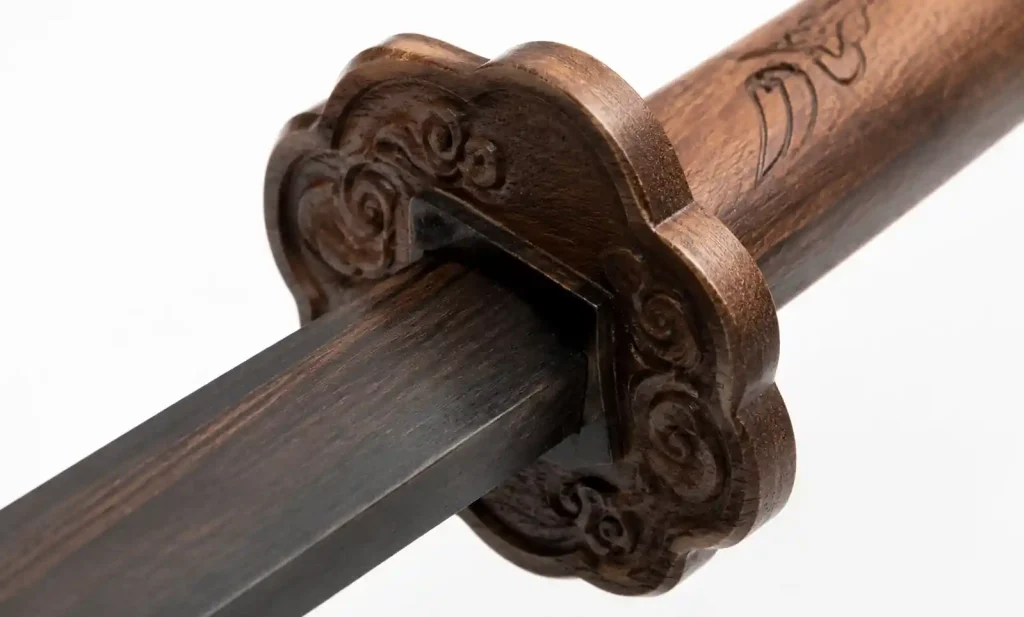
Carving Detail Quality: If the weapon features decorative carving—dragon motifs, Celtic knotwork, runes, or ornamental patterns—examine the execution carefully. Quality carving shows appropriate depth (typically 2-4mm for decorative elements), clean edges, and thoughtful composition. Poor carving appears shallow, with fuzzy edges, incomplete elements, or patterns that don’t flow naturally with the weapon’s form.
Hardware Quality: For pieces incorporating metal components (guards, pommels, decorative fittings), assess the metal quality. Solid brass or steel components indicate quality construction, while thin sheet metal or pot metal alloys suggest cost-cutting. Hardware should fit its purpose—functional training weapons need durable, securely attached components, while decorative pieces can use lighter materials if they’re aesthetically appropriate.
5. Finishing Techniques That Separate Good from Great
The finishing process reveals the craftsman’s attention to detail and commitment to quality. Superior finishing protects the wood, enhances its natural beauty, and provides the tactile quality that distinguishes premium pieces from basic production work.
Surface preparation is the foundation. Quality pieces undergo progressive sanding through increasingly fine grits (typically 150 to 400 grit or higher), creating a silky-smooth surface that showcases the wood’s natural character. Shortcuts in sanding—stopping at coarse grits or sanding unevenly—leave visible scratches and rough patches that no amount of finish can hide.
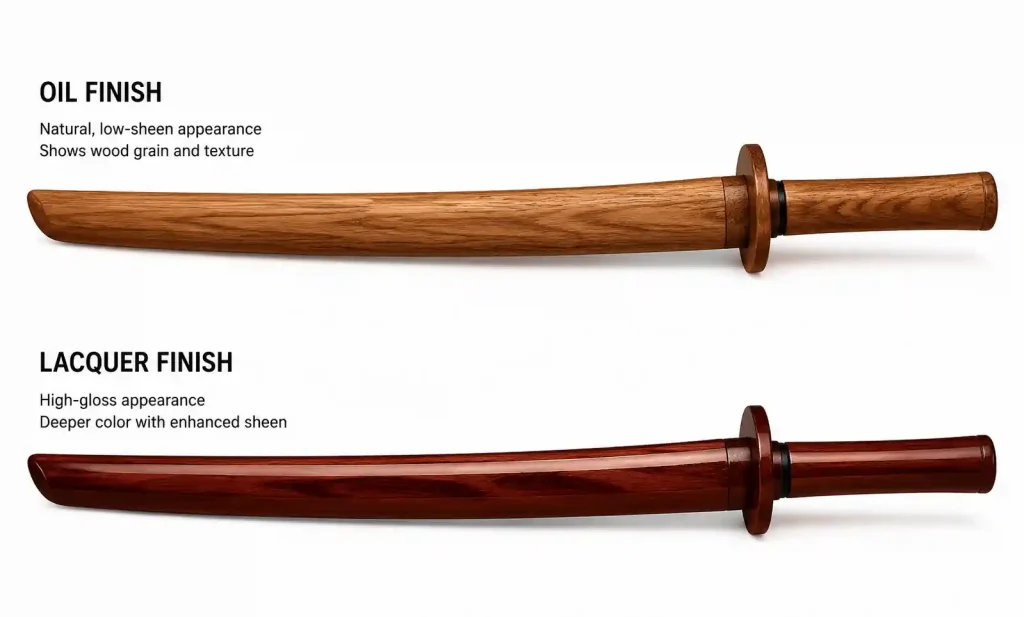
Traditional finishing methods for wooden weapons include multiple approaches. Oil finishes (linseed, tung, or Danish oil) penetrate the wood, enhance grain patterns, and provide a natural, low-sheen appearance preferred for traditional training weapons. These finishes require multiple applications with adequate drying time between coats. Quality oil finishing produces a rich, deep color with subtle sheen.
Lacquer and polyurethane finishes offer more protection and higher gloss, appropriate for decorative display pieces. Quality application shows even coating without runs, drips, or orange-peel texture. Multiple thin coats produce superior results compared to fewer thick coats. Hand-rubbed finishes, where the final coats are applied and buffed by hand, create particularly beautiful results with depth and clarity that spray-only finishes can’t match.
For training weapons, the finish must balance protection with grip. Overly glossy or slick finishes make weapons difficult to control during practice. Quality training weapons often feature oil or wax finishes that provide protection while maintaining appropriate friction for secure handling.
Some premium decorative pieces incorporate traditional techniques like pyrography (wood burning) for accent details, inlay work with contrasting woods or materials, or traditional Asian urushi lacquer application. These specialized finishes require additional skill and significantly increase production time, which should be reflected in wholesale pricing.
Color Treatment: Natural wood color is often preferable, showcasing the material’s inherent beauty. However, staining can enhance consistency across large production runs or achieve specific aesthetic goals. Quality staining produces even color without blotchiness, enhances rather than obscures grain patterns, and uses lightfast pigments that won’t fade quickly. Cheap staining appears muddy, hides wood character, or shows uneven application.
| Finish Type | Advantages | Las mejores aplicaciones | Maintenance Requirements |
|---|---|---|---|
| Oil Finish (Tung, Linseed, Danish) | Natural appearance, enhances grain, easy to repair | Training weapons, traditional replicas | Periodic reapplication, simple cleaning |
| Hard Wax | Low sheen, good grip, traditional feel | Practice weapons, historical replicas | Occasional rewaxing, no water exposure |
| Polyurethane | High durability, moisture protection, glossy finish | Decorative display pieces, outdoor display | Minimal maintenance, clean with damp cloth |
| Lacquer | Beautiful depth, traditional Asian pieces, glossy finish | High-end decorative swords, collector pieces | Dust regularly, avoid harsh cleaners |
| Natural/Unsealed | Showcases raw wood, traditional feel | Certain historical replicas, rustic pieces | Requires careful handling, limited moisture exposure |
This finishing comparison helps you match finish types to your inventory needs and customer preferences. Training weapon customers typically prefer oil or wax finishes, while decorative piece buyers may appreciate lacquer or polyurethane protection.
6. Red Flags: Signs of Poor Craftsmanship
Recognizing warning signs of substandard craftsmanship protects your wholesale investment and prevents customer dissatisfaction. Certain defects and shortcuts consistently indicate suppliers prioritizing volume over quality.
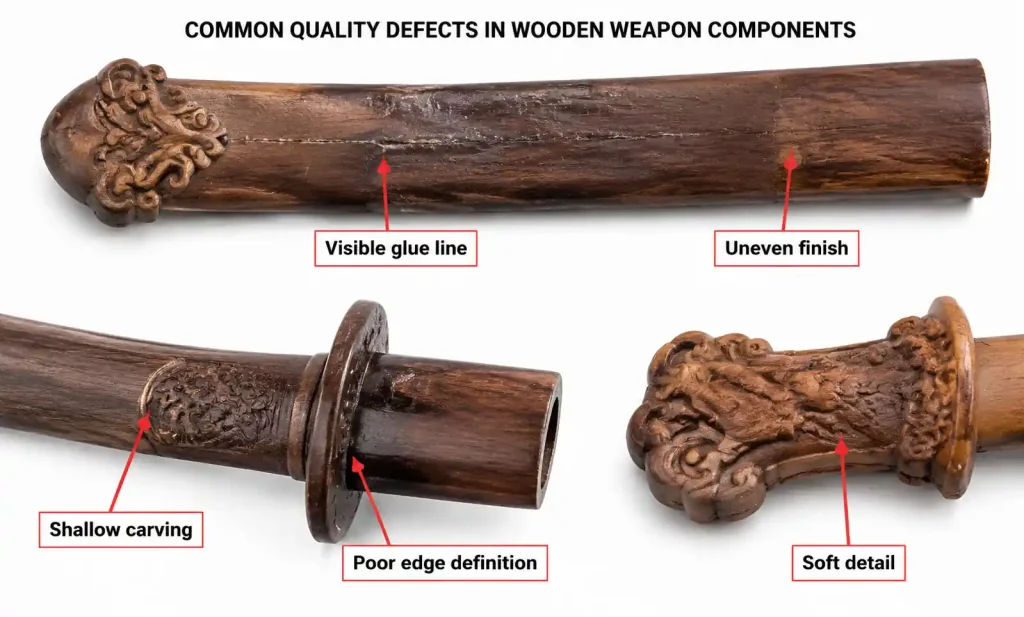
Visible Glue Lines and Poor Adhesion: While laminating wood for certain weapon components is acceptable, visible glue lines with squeeze-out or gaps indicate careless assembly. Quality joinery shows nearly invisible glue lines with tight, uniform bonding. Yellow or white glue visible on finished surfaces suggests rushed production without proper cleanup.
Inappropriate Wood Choices: Pine, poplar, or other softwoods have no place in weapon replicas marketed for anything beyond pure novelty use. If a supplier offers “budget training weapons” in soft woods, they’re selling unsafe products. Similarly, green or improperly dried wood will warp and crack after purchase—problems that appear within weeks or months.
Incomplete or Shallow Carving: Decorative elements that appear pressed or burned rather than carved, shallow relief work that barely breaks the surface, or carved details that fade out or disappear partway through patterns all indicate rushed or unskilled work. Quality carving maintains consistent depth and crisp detail throughout the design.
Poor Proportions and Asymmetry: While subtle variations are normal in handwork, obvious asymmetry—guards that sit crooked, blades that curve or twist, uneven edge bevels—indicates lack of craftsmanship or quality control. Sight down the blade from the pommel; it should be straight without warping or twisting.
Finish Failures: Common finishing problems include tacky or sticky surfaces (insufficient drying time), runs and drips (poor application technique), cloudy or milky appearance (moisture contamination), uneven coverage exposing bare wood, orange-peel texture (incorrect spray technique), and finish that chips or peels easily (inadequate surface preparation or incompatible products).
Missing or Shallow Details: Historical replicas should honor the original weapon’s design elements. Simplified or omitted details—undersized tangs, missing fuller grooves, absent or incorrect guard styles—suggest the craftsman is working without proper references or doesn’t understand the weapon’s historical form.
Inappropriate Hardware: Loose, rattling, or misaligned guards and pommels indicate poor fitting or inadequate securing methods. Thin stamped-metal components that bend under light pressure aren’t suitable for any quality replica. Visible screws or modern fasteners on pieces marketed as traditional replicas break authenticity.
When evaluating wholesale suppliers, request multiple samples from different production batches. Consistent quality across samples indicates reliable production standards. Significant variation between samples suggests inconsistent craftsmanship or inadequate quality control processes.
7. Evaluating Wholesale Suppliers and Production Standards
Selecting the right wholesale supplier for wooden weapon replicas requires assessment beyond individual product samples. The supplier’s production capabilities, quality control systems, customization flexibility, and business practices determine your long-term success.
Production Transparency: Quality suppliers willingly discuss their production methods, wood sourcing, craftsman training, and quality control processes. They can explain the steps from raw wood to finished product and identify which operations are machine-assisted versus hand-executed. Reluctance to discuss production details or vague, evasive answers suggest potential quality or ethical concerns.
Customization Capabilities: The ability to accommodate custom specifications—specific wood types, dimension modifications, custom carving or branding, or finish preferences—indicates a supplier with genuine manufacturing capabilities rather than a reseller. Discuss your specific needs and evaluate their technical understanding and willingness to provide customized solutions.
Sample Policy and Prototyping: Reputable wholesale suppliers offer sample ordering at reasonable prices or with credit toward production orders. They should provide multiple product samples representing their range, and for custom orders, they should offer prototype development with clear timelines and revision processes.
Quality Control Documentation: Professional suppliers maintain quality standards through documented processes. Ask about their inspection procedures, defect rates, and how they handle quality failures. Suppliers confident in their craftsmanship provide clear quality guarantees and straightforward return/replacement policies for defective items.
Scalability and Consistency: Can the supplier reliably produce your required volumes while maintaining quality? Small artisan workshops may produce exceptional individual pieces but struggle with larger orders. Conversely, large factories may handle volume easily but with inconsistent craftsmanship. Assess whether their production capacity and quality control scale matches your ordering needs.
Communication and Service: Responsive, professional communication in the inquiry and sampling phase predicts the relationship during production and problem resolution. Language barriers, time zone differences, and cultural business practice variations require patience, but fundamental respect, transparency, and responsiveness should be consistent.
Pricing Structure and Value: The cheapest wholesale price rarely delivers the best value. Assess pricing relative to materials, craftsmanship level, customization flexibility, and service quality. Suspiciously low pricing often correlates with shortcut materials, rushed production, or unreliable quality. Conversely, premium pricing should be justified by demonstrable quality advantages, unique capabilities, or exceptional service.
References and Track Record: Established suppliers should provide references from current wholesale customers (with those customers’ permission). Industry reputation, longevity in the market, and documented customer satisfaction provide valuable context. Search for reviews, check business credentials, and verify business registration where possible.
Ethical and Sustainability Practices: Inquire about wood sourcing practices, environmental policies, and craftsman working conditions. Responsible suppliers source wood legally, preferably from certified sustainable sources, and maintain ethical labor practices. These factors increasingly influence customer purchasing decisions and reflect overall business integrity.
8. FAQ
What’s the typical price difference between hand-carved and machine-made wooden weapon replicas?
Hand-carved pieces typically cost 40-150% more than comparable machine-made replicas, depending on complexity and detail level. Simple training weapons show smaller premiums, while elaborate decorative pieces with extensive hand-carving command significantly higher prices. Semi-custom pieces with machine roughing and hand finishing fall in the middle range. The premium reflects skilled labor time—a complex hand-carved sword may require 20-40 hours of craftsman time versus 2-4 hours for machine production.
How can I verify that “handcrafted” claims are genuine?
Request detailed production photos showing works in progress at various stages. Genuine handwork shows the piece evolving through rough carving, detail work, and finishing. Ask specific questions about tools used, techniques for particular elements, and production time per piece. Request slight customizations to a standard design—truly handcrafted operations can accommodate minor variations, while resellers claiming handwork cannot. Video calls to view the workshop and meet craftsmen provide additional verification for significant wholesale relationships.
What minimum order quantities should I expect for quality wholesale wooden weapons?
MOQs vary significantly based on customization level and supplier size. Standard designs from established manufacturers may have MOQs of 50-100 pieces per design. Semi-custom work typically requires 20-50 pieces. Fully custom designs might need 10-30 pieces to justify setup and production. Smaller artisan workshops often work with lower MOQs (5-20 pieces) but at higher per-unit costs. Be cautious of suppliers demanding very high MOQs (500+ pieces) for standard items—this suggests inflexibility or non-manufacturing reseller operations.
Which wood types are acceptable for functional training weapons versus decorative replicas?
Functional training weapons require hardwoods with straight grain and impact resistance: white oak, red oak, hickory, ash, hard maple, or beech. These woods withstand repeated impact without splintering or breaking. Decorative replicas can use a broader range including mahogany, walnut, cherry, teak, or exotic hardwoods selected for appearance rather than impact strength. Never accept softwoods (pine, cedar, poplar, fir) for training weapons regardless of price—they lack structural integrity and present safety hazards.
How do I assess quality in wooden weapon replicas without in-person inspection?
Request high-resolution photographs from multiple angles, including close-ups of carved details, finish quality, grain patterns, and joinery. Ask for photos of the same design from different production batches to assess consistency. Request detailed specifications including wood type, dimensions, weight, moisture content, and finish types. Video calls allow real-time examination where you can request specific views or tests. Order multiple samples from different product lines before committing to large production orders. Establish clear quality standards in writing with photo references for acceptable and unacceptable characteristics.
What warranty or guarantee should quality wholesale suppliers provide?
Reputable suppliers typically guarantee their products against structural defects and craftsmanship failures for 30-90 days after delivery. This covers issues like wood splitting, finish failures, joinery separation, or warping from improper drying. They should offer replacement or credit for defective items within this period. Clarify what’s excluded—damage from misuse, normal wear from training, or customer preference issues typically aren’t covered. Get warranty terms in writing before placing production orders. Suppliers unwilling to guarantee their workmanship for at least 30 days should raise concerns.
Can wooden weapon replicas be customized with branding or specific design elements?
Most quality manufacturers offer customization including carved or pyrography branding, custom handle wraps, specific dimension adjustments, wood type selection, and finish preferences. More extensive customization like completely custom designs, unique carving patterns, or special inlay work is possible but typically requires higher MOQs and prototype development phases. Discuss customization capabilities early in the supplier evaluation process, provide clear specifications and visual references, and expect prototype samples before full production begins.
How long does production typically take for wholesale orders?
Standard designs from stock or regular production typically ship within 2-4 weeks after order confirmation. Semi-custom orders with minor modifications usually require 4-6 weeks. Fully custom designs need 8-12 weeks including prototype development, approval, and production. Complex carved pieces or specialty finishes may extend timelines further. Always confirm production schedules in writing and build buffer time into your inventory planning. Be wary of suppliers promising extremely fast turnaround on custom work—this often indicates they’re reselling rather than manufacturing, or that they’ll sacrifice quality to meet unrealistic timelines.
Conclusión
Sourcing good wooden weapon replicas in bulk isn’t rocket science, but you do need to know what to look for. The key is paying attention to wood type, construction, finish, and who you’re buying from. Straight‑grain hardwood, balanced weight, solid joinery, and a finish that protects without hiding the wood’s natural look—those are your non‑negotiables.
And remember: the cheapest price usually isn’t the best deal. Good craftsmanship from a reliable supplier saves you returns, complaints, and reputation damage. Smart buyers know the difference.Before you place a big order, get samples from a few suppliers, test them under real‑use conditions, and check consistency across batches. Put your quality expectations in writing, keep communication open, and stick with suppliers who care about quality as much as you do.
Whether you’re stocking a shop, supplying a training facility, or serving collectors or film production, these basics will help you source pieces that honor the craft and keep your customers happy.